
InterviewDamien Dubrovnik
Christian Stadsgaard and Loke Rahbek — the duo behind Damien Dubrovnik and the founders of Posh Isolation — on the origins of a project, the seduction of performance, and why sounding decent has never been interesting in the entire history of music.
STM 165 — Damien Dubrovnik Mix
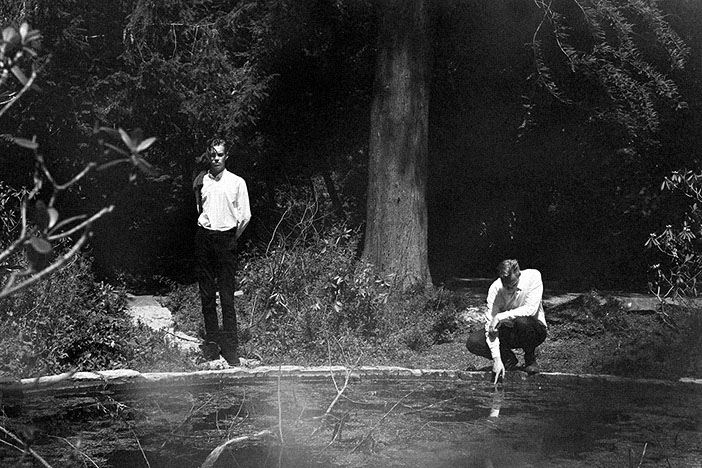
Photo by Jonas Bang
In 2009, in Copenhagen, Christian Stadsgaard and Loke Rahbek started a cassette label in Stadsgaard's apartment. The first release was by Damien Dubrovnik — their own project — and the label was Posh Isolation. By 2015, when this interview was conducted, the label had issued over a hundred releases and become one of the most important nodes in a specific international network: noise, industrial, power electronics, and the outer edges of whatever techno was becoming in the hands of people like Puce Mary, Varg, and Lust For Youth. The label's inception came with Damien Dubrovnik's debut, and the two have been inseparable ever since — without one, the other would most likely not exist.
The two men are 14 years apart in age — Stadsgaard born 1975, Rahbek 1989 — and arrived at noise from different directions. Stadsgaard through a sensitivity to electronically generated sounds others found irritating, a fascination with early electronic music, and a 2000 performance by Francisco López in Copenhagen — blindfolded audience, precise, delicate, very loud — that reset his idea of what a concert could be. Rahbek through painting, through a gallery opening where his own work dissolved in small talk and white wine, and through the noise show he stumbled into immediately after, in a small basement room with thirty people, where the volume demanded a decision: either you are here, or you leave. He stayed. He is still there.
Damien Dubrovnik's live performances are known for incorporating elements of performance art and body acoustics — visceral, unpredictable, confrontational in the precise sense that the audience is directly engaged rather than passively observed. The studio work spans six LPs, released across Posh Isolation, Luke Younger's Alter, and Silent Servant's Jealous God — each record a different angle on the same fundamental question: how much weight can sound carry before it becomes something else. The 2017 album Great Many Arrows, Posh Isolation's 200th release, introduced acoustic instruments — organs, cellos, violas, wind — set against the electronics in a way that made the collisions more, not less, terrifying. The project's movement towards more experimental electronics mirrors the label's own constant renewal and refusal to settle.
This conversation was conducted in 2015, with both members responding separately. It covers the beginnings, the philosophy of noise, the nature of seduction, the role of lies in art, and the strange productivity that comes from weakness. Reading it in 2025, what holds up is not the answers but the quality of thought behind them — the sense that both men are genuinely trying to say something true rather than something useful.

Damien Dubrovnik — Live Performance
In my early teens, I never imagined that I would make music, and to this day I still struggle a little with that term — being a musician.
I decided that I wanted to work with sound when I realised that, for what I wanted to do, it was a stronger tool than images are. The show that made me decide was, funnily enough, a show that Christian had set up in Copenhagen when I was still in my teens. I was doing an opening show for a gallery and was saddened to see my paintings and collages drowned in the small talk and the free white wine at the reception to the point where when I looked at the walls, I did not recognize them myself. I left the opening early and more or less by chance ended up at a noise show. There were 30 people in a small basement room and it was the exactly opposite environment to the gallery I had just left — but I remember thinking that the sheer volume and personality put into it by the performer would have been impossible to drown, no matter the size of the room or crowd, no matter what the small talk was about and no matter if the free white wine would have flowed endlessly. The volume demanded that you either had to witness it or you had to leave. The performance forced anyone in the room to decide — do I want to be here and experience this or not. I stayed — I am still there.
And still, I don't know if I am a musician. I suppose it depends on how we define the term. Is someone ripping out his own teeth a dentist?
ChristianI, on the other hand, have no problem with the term "musician" or at least "electronic musician". Most of the original electronic music was way more abstract than the music we do as Damien Dubrovnik, and I think many of the original strategies and techniques of electronic music are in line with what we do today. And I do feel very connected to that part of modern history.
I was always very sensitive to sounds, especially electronically generated sounds other people would find annoying. Very late in my life I got into making these sounds myself. And I was always into music, but only very late in my life did I get into making music.
I can't remember the first sonic experience that made an impact on me, but seeing — well, everybody in the audience was blindfolded — Francisco López in Copenhagen around 2000 was the first electronic concert that really made a big impact on me. It was precise, delicate and very loud and physical, and that was clearly appealing to me. In many ways my preferences have not changed in the past 15 years.
Different emotions and stories require different languages and settings. In general I think you are right, but there are so many exceptions to this rule. In modern mainstream music, everything is extremely condensed. You need to reach your emotional conclusion within very few bars of music and while it works for some things, I think applying that method to other forms of music or other forms of expression would be a very big mistake. Some things need to take time, some things need space, and sometimes we need to walk in the opposite direction than where we have actually been going for a while. In my experience we are often a lot more awake when we are waiting for someone to say what we want them to say than when they actually do.
ChristianSometimes less is more and sometimes less is a bore. Essentially I think you are right, but expressing emotions over a duration of time — as in music — is a very complicated matter.
"Sounding decent has never been interesting in the entire history of music."
— Christian Stadsgaard
It would be just as easy to argue that when technology gets more advanced there is a lot more to consider. The options are endless. I like my walkman and I like my computer — they serve different purposes and they make a good team.
ChristianI would like to think less and just let the music flow out of my machines like a natural extension of my body. But unfortunately that is very far from the case. I'm sure making something that sounds "decent" has become more easy with the democratization of electronic equipment, but sounding decent has never been interesting in the entire history of music.
There are a thousand aspects to consider. One key aspect is that our tools of communication have changed and are still changing. Today I have talked to as many people outside of Denmark, through computer and telephone, as I have met people face to face. I have talked to my friend in Stockholm about his upcoming record, a girl in America about a potential show, another in Berlin about this interview and someone in Canada about something completely different. I have sent an e-mail that reaches a potential crowd of thousands in one click. And I have met my old friend for a glass of wine and a man that works in the same street as where our office is, and chatted for a minute. As any form of expression we work with is in its nature communicative. To witness these new languages emerging while others are disappearing is something we have to be aware of both as human beings of course, but also as artists.
ChristianArt and technology have always walked hand in hand, and probably always will. Whatever happened in the sphere of technology had an impact on all walks of life, including art and music. What puzzles me is that even though we have seen an explosion in electronic technology and music equipment over the past 20 years, I can't really point to any fundamentally new music style since jungle and early drum n' bass. Surely there have been developments in music, but structurally over already established forms of music. I don't blame technology, but it does leave some food for thought.
I won't comment on the overall progression of humanity. I don't think it is our place. I will say: Honesty is key, if we want to be totally free.
ChristianI don't think there is such a thing as an overall progression of humanity. I think there are different frames of thinking from time to time, different epistemes if you like, but some kind of Hegelian idea of progression I'm really sceptical about. And I must say that after seeing mass-mediated pictures of drowned refugee children, children of the age of my three year old boy, I find it very hard to talk about the concept of humanity at all.
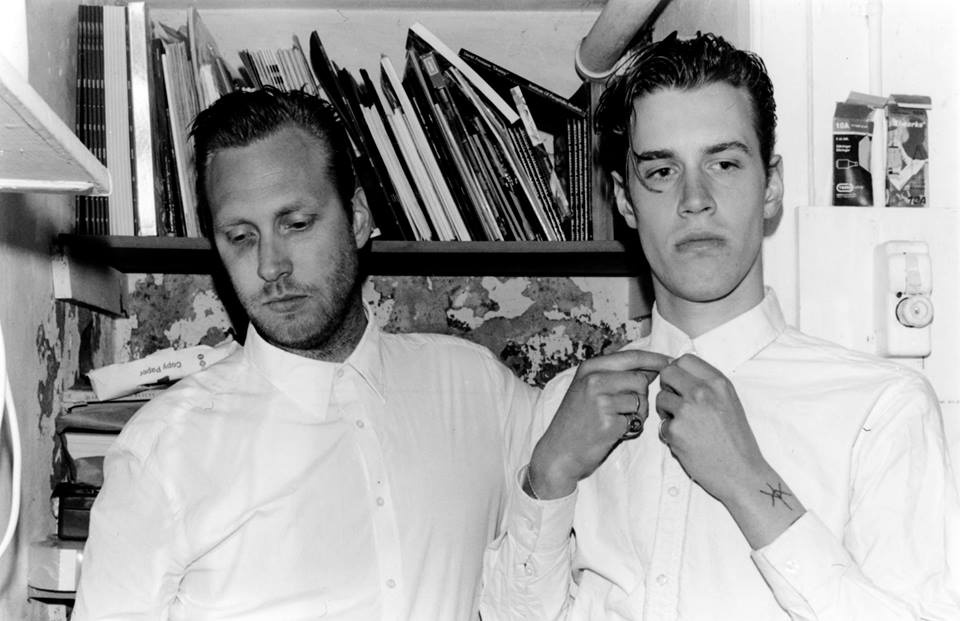
Damien Dubrovnik
Vegas Fountain is essentially about seduction. The aim was to make a piece of work that addresses the nature of seduction and performance as a seductive performance in itself. A theatrical play about the nature of a theatrical play.
While touring with the material that eventually became Vegas Fountain, I realised that I was lying — that while I was saying something I believed to be true, it was a lie at the same time. That art is no place for truth. We don't want truth on stage, it would be dreadful to watch. We want the exaggerated movements of a well-performed lie to help us understand something true, namely the artist's truth, and if it is skillfully done, some of that will become our truth. Picasso formulated it well: "We all know that art is not truth. Art is a lie that makes us realize truth. The artist must know the manner whereby to convince others of the truthfulness of his lies."
When David Bowie can seduce an audience of 50,000 people in a concert, it is of course not his voice alone that does it, nor is it solely depending on the melodies of the band performing. It is his masterful seduction — we essentially fall in love with him, or rather, he leads us on and we fall in love with the perception he let us have of who he is. In these situations I have found that I can feel almost more than I do in "real" emotional interaction. I have loved actors and musicians with more passion than any real lover I have had in my life. The pure emotion is essentially possible because it takes place in a lie.
That is why performative art creates idols in a different way than painting does. When someone paints a beautiful picture we are moved and impressed. When someone performs a powerful role, whether a musician or an actor, we want to consume them — we essentially want to be them. Vegas Fountain is a theatre about seduction, and the theatre that takes place on, as well as off stage.
ChristianSeduction is a play where both parties know what's going on, but pretend they do not. It's a game, and if you break the rule by being too straightforward and stating what your intentions really are, you ruin the game. I don't think anyone would benefit from that.
"Art is no place for truth. We want the exaggerated movements of a well-performed lie to help us understand something true."
— Loke Rahbek
It is impossible to control how other people interact with a piece of work. I think of Vegas Fountain as a room. What people choose to do in that room is entirely up to them. I am very flattered and it makes me happy and proud if anyone would choose to spend time in there.
ChristianI prefer to see my music as an open text. I would choose other means of communication if I wanted people to get a specific message. And even there I know there would be a question of interpretation.
I am not sure what you mean by art aesthetics but presentation is important to us. It really isn't very different from applying make-up before you go to a party or wearing a nice shirt to a meeting. The cover and potential writing is the chance you have to indicate a scene or a room for the music to be listened in. It is the first impression. First impressions are said to be very important, especially if you want to seduce someone.
ChristianWe see Posh Isolation as a unity. Each release is a brick in a building. And bricks must fit together to build anything. We have been doing this from the very beginning when there were hardly any sales, and we never saw it as a sales tactic.
I like a lot of different artists and a lot of different movements for a lot of different reasons. Lately I have been really into Michael Jackson.
The weaknesses are all over the work. There is hardly any reason to mention them further, really. I smoke cigarettes mainly because I think it makes me look really cool.
ChristianI find the distinction between strength and weakness a bit off. It is all part of the human condition and what is strength and what is weakness I'm not even sure anymore.
I have never lived without it, but it is also not an emotion that I am very interested in. I found that I get very little done out of sheer negativity. I don't think of Damien Dubrovnik as negative music — to me Damien Dubrovnik is about celebrating emotion, both negative and positive. It is about the beauty that we human beings can feel.
ChristianI have absolutely no idea about humanity and its relationship with negativity. But as Loke said, Damien Dubrovnik is about celebrating emotions — and I would add — the human condition in general. Whether it was positive or negative, strength or weakness, it is all part of everyday life. I see it as an open text, and if I can make music that moves people emotionally for whatever reason, either to tears or rapture, or both, I would be really pleased. Because that's what it is doing to me.
Damien Dubrovnik

