
Elysia
Crampton
An archival conversation / Unsound 2015Who gets to imagine the future?
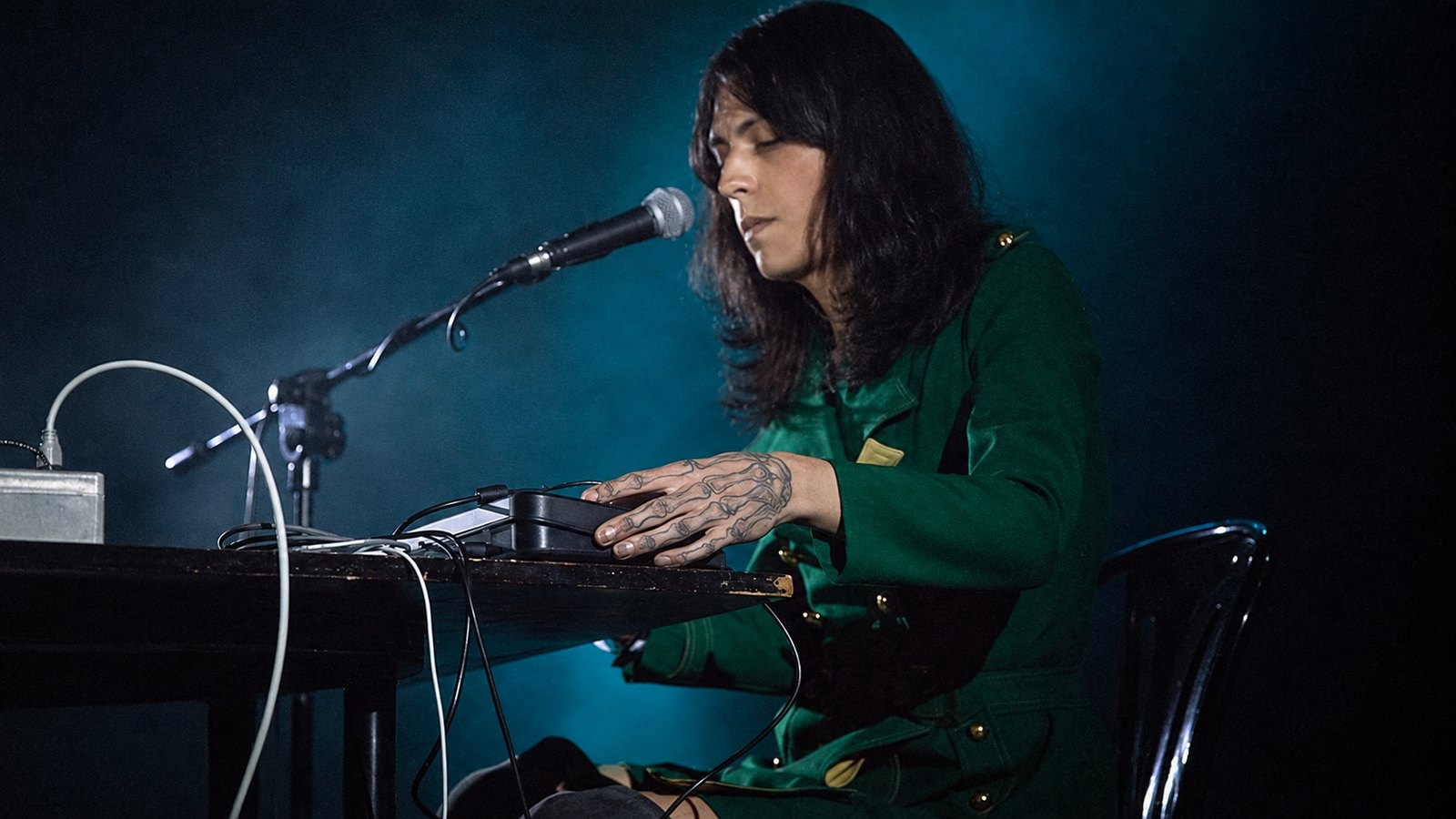
At Unsound 2015, Paulius Ilevicius met Elysia Crampton in a café in Kraków’s Kazimierz district. American Drift provided a starting point for a conversation about identity, science fiction, movement between countries and the different histories a listener brings to a piece of music.
The artist now works as Chuquimamani Condori. We retain the name used at the time of the interview, along with the original questions and answers. The conversation was first published in February 2016; Justinas Mikulskis’s new afterword follows its concerns into the present.
Introduction and archive edition by Justinas Mikulskis.
In this conversation
01 / ConversationExperience, expression and agency
Your music has a very strong contextual background. How does it influence your sound? How is it that something dealing with such deep and complicated issues has this playful quality? What is the connection between the ideology and the construction of sound?
Before starting to speak how does it relates to the music, I want to talk about the general background and the genesis of this ideological foundation that you are talking about. I have always had a natural love for critique, for the written word and for reading. Part of it comes from that. But the other part comes from just navigating my own experience as a trans woman of colour, as someone of mixed heritage, as someone who is identified and responded to as brown. You know, I was just saying the other day I ain’t talking about politics, but if you ask me about it I will not turn it down. Well, I like thinking along those lines. Just using a bathroom for me as a trans-woman of colour is a political act. Whether I use a men’s bathroom, a women’s bathroom or a handicapped bathroom, it becomes this really bold political act and statement. And sometimes it is a huge burden for me in fact. Sometimes I just want to fall and die, but in my more empowered moments I take that and I own it. I am like, well ok, each little moment of my life, when I need to pee is excruciatingly politicised, because of the culture that I live in, because of this system of oppression that we live in. And I feel like this was handed to me and I have to do something with that. Part of it comes from a call, from being, from my lived and embodied experience. And that lived and embodied experiences comes to communicate with my love of critique.
Then going back to this issue of simplicity of the music, that is just how it comes across. Obviously we learn to allow the simplicity to signal for us, that there isn’t anything complex about it. Just because it is simple on one level, it does not garner complexities on another. I can’t deny my awareness of that and so bringing in all this conversationalist texts along with it justifies it as the complex thing.
Continuing talking about music, the current trend in the experimental music scene for better or worse is to focus on the qualities of sound, the way how they interfere, their sonic properties, layers and so on. There is also a trend for live performances and albums to be continuous. Your sound has a very straightforward digital quality and it is very eclectic. Your Unsound performance could be divided into two parts consisting of textual landscape and soundscapes. Is it a conscious decision to construct music in this way?
If you noticed and read the things I spoke, I talk so much, but you can realise that I am not really talking specifically about the music. For me, the music is still a natural part of my expression. There are thoughts I express, but I learn from those natural processes of just letting my body and my mind express itself in this kind of raw and uncontrolled way.
Now as you get more exposure and reach wider audiences, did it influence your relation to your music? How much control in your art do you have for the message to be understood? Do you still feel in control of your message when it gets wider exposure? Or does it not change anything?
Well, I think in the attention economy that we live, in this world of signals that we live in, it would be ridiculous not to acknowledge, not to try to have some input in controlling my own agency as it navigates with the music. Obviously, the music is that thing that I navigate in the world with to gain my own agency and I gain my own agency through it as well. But the music in and of itself has its own agency and I can’t control who it finds, what relationships it causes and garners. I respect that, but it is also a matter of knowing, that when people encounter the music, they are going to put in their histories, perspectives. As much as I want to play with the agency of the music, its freedom to become what it is going to become, I cannot deny my own agency as well.
“But the music in and of itself has its own agency and I can’t control who it finds, what relationships it causes and garners.”
02 / ConversationWho inhabits the future?
Going back to your last release “American Drift” and your performance at Unsound, I noticed that there is quite a bit of sci-fi imagery, lots of space references. How do you thing this cosmic and sci-fi element relates to the question of identity that you explore? How did it come into being?
I have always had an interest in the universe, space, time and beingness. It relates in one way on a very materialist level. Everything that is in our world came from the stars. I was just trying to get a grasp on the origins of water. I have just read an article how water has memory. But even the genesis of water itself has this alien thing. The genesis of photospheric light, the genesis of the chemicals that make up our bodies are all from that place. So yes, they are always connected.
Are you interested in sci-fi as a genre?
What I love about sci-fi is that with its fiction it creates possibility spaces. I think those areas have not been the sites for critique and interrogation for too long. We just assume that because they are fantasy, they cannot be critiqued. But we can even see those histories of sci-fi fantasies and fantastical thinking, where even the bodies of people of colour have been excluded. And I think it is really precious for us to reclaim these possibility spaces, especially for trans sci-fi writers, trans fiction writers, queer-fiction writers. I think that whole aspect of futurity and alternate reality ultimately shapes our reality. That virtualness is so tied to our realities, that they ultimately shape the future of those realities.
So these futurist worlds influence the way we perceive the present?
Definitely. Even if you look at the 70’s, the sci-fi mentality, genres, stories from that time, you see them as branches. They branch out of ideology and the life of that time. You can’t pull them apart.
03 / ConversationPlace, movement and belonging
Speaking further about your music and about “American Drift”, I find that the location is quite a prevalent concept and I even find your art a bit psychogeographical. Having lived in many places, how do you think the location influences the person’s identity from the psychogeographical perspective?
I love this word “psychogeographical”. I think, it is a great word. Maybe going back to what we have just talked about, this sci-fi and these possibility spaces branch out of the flow of space and time. They generate those sci-fi realms. In the same way there are all these spaces that inform and in their strange ways they also embody the way we experience the experience. You know, the americanness is not just limited to the geographical site, the continent itself. Americanness spreads, we can even feel it here, in this coffeeshop that we are talking in, in the festival. There is a trans-corporeal element to any geographical site that we would consider in that way. And so this trans-corporeal is like a spiritual component to the way geography moves and the way it becomes a story and the way it moves through us, the same way we move through and around it.
I have noticed that except La Paz you mostly lived in smaller towns. Is it a conscious decision to avoid large metropolitan places or more a coincidence? Do you feel these metropolitan places like New York or London are more liberating or restricting?
Well, I can put some shade on New York right now as it is a very expensive place to live. I grew up in Los Angeles too. It was an interesting place to navigate. I learned a lot there and I will always feel connected to it. My living in smaller villages and towns in some aspect is a reaction to growing up in the city, but when I was very young we lived in a very rural town as well. I would say maybe 90 percent of the time it was not even out of choice. It was because we could not afford to live anywhere else. I would say 99 percent of my mobility and geographical movement influences the album. It is just out of the necessity for me to survive. I don’t live in the USA anymore, because I can’t afford to live there anymore, which is why I live in Bolivia now. For the same reason I was living in Virginia, because I could not afford to live elsewhere. I am a poor woman and I follow where the opportunities are.
In the music video for “Fire Gut” and in your song titles there are some references to car culture and the symbol of a car is quite prevalent in your art. Where does that come from and what does it mean to you?
Well, I just love cars, I love everything about them. It is really just the way of celebrating them, the entities of whatever they are, their carness, their truckness, and not necessarily thinking about the representational qualities or their symbolic structure, just enjoying them for what they are. I think that sounds very apolitical, but that is where my headspace was when I was doing it. Cars serve us as a reminder of the fact that we think we are so advanced and on the brink of another revolution. We think that the industrial revolution is behind us, but we still live in the system that depends on these poor countries being industrialised, on these fossil fuel giants.
In that aspect it is crazy to me and it always reminds us where we actually are. In Bolivia mining was always associated with settler colonialism, the colonialist powers and their way of navigating power to indigenous people. It continues to this day with Earth mineral mining for the computers, but even I use an Apple computer, all the DJs I saw the other night use Apple computers, you have one. It is like those two systems were switched out, but it is the same thing. I just wonder if there is a way to get out of that.
04 / ConversationPop culture and its histories
As there are many elements and references to pop culture in your sound, generally speaking how do you see pop culture, the present situation of it, and do you think that pop culture by its very nature can have the capability of addressing serious social issues? If not, what needs to be changed that it would happen?
I came from an old era already. Even five years ago I feel that it was different, but I am an older lady now. But I noticed that I don’t like a lot of new pop stuff. I am not into it as wholeheartedly as I used to be six or seven years ago when Britney’s femme fatale came out. I remember that moment and it felt so good. It does not make any political or ideological stance, but I feel like its naivety, the feel of just being here offered what it offered despite just being great music. I feel that maybe music’s strongest capacity is when it does not try to do anything else. It just does what it does.
Do you think that pop music of the past was better in tackling identity and social issues?
I don’t think so, I don’t think it ever was, but we use what we can. We navigate the world and we survive it the way we can. Even if part of it is taking this music and making it our own. Even when I started writing music, I guess that was what essentially I was doing. I used to take pop vocals and put my own music on it, because I wanted it to be that much more mine. But if we think about ideas of sovereignty and this whole legacy of sovereign and how it affects the individual, this idea that things can be owned and that even one owns oneself, this idea of ownership, I am not sure if it is necessarily a positive thing. But positive or negative are notions that needs to be questioned and explored.
But back to pop music, the older I get the further away from pop music I get. I would rather play something like a fifteen minute boring Carl Orff song. That’s where I am right now. I am sure the pendulum might swing, maybe I will get back into a Nicki Minaj track or something. But I have never liked intellectual communities’ hurriness to dismiss pop music as being arbitrary just because it does not directly address these deep things that we use to legitimise intellectual thought.
05 / ConversationListening towards Bolivia
You mentioned before that your influences come from quite a wide variety of genres, even metal? Could you elaborate a bit on that? What are your present musical influences?
Currently since I have been living in Bolivia I have been getting back to the psychedelic legacy of that period, also the noise legacy from Chile, Argentina, Peru from the early 1930’s, the psychedelic and prog rock legacies of Bolivia and Peru from the 60’s, also the metal legacies from the late 70’s up until now. I think metal is one of the most exciting genres coming out of Bolivia right now. At least in my opinion.
Is the scene strong in Bolivia in general?
That is the thing, it is not as strong as I wish it was. Somebody told me a statistic few years ago just for the city of La Paz. It tells that there is a 95 percent of teenagers, a crazy statistic that says that there is a high population of young people there. From this population you expect that they would be coming out more in terms of music styles and new innovations, but you don’t see it. And I think it is also because Bolivia as a whole is still dealing with this legacy where the national and the indigenous music has been rewritten. And this all happened around the late 50’s going into the 70’s and that still affects even the way the world interacts with Bolivian music. It isn’t what Bolivian music was, what it should be and unfortunately that became a closure when it happened historically. It did not become a branch of the indigenous legacy that up until then had managed to continue this despite colonisation, despite oppression by other civilisations before the Europeans even arrived in South America. But with the things that have been going on there I see the possibility for new indigenous styles to be reemerging and for them to be finding new voices. Even now with the reclamation of Afro-Bolivian Saya by the black Bolivian people themselves. I think that it is amazing that that happened. You know, even with this concept of what their music was supposed to be, they are taking it back into their own hands. I am hoping that we see it maybe in the next few decades and I hope that I could contribute to that in some way being of Aymara descent.
Keeping possibility open
I wanted this conversation back in the archive because it asks more of the word “experimental” than a description of unusual sound. Paulius keeps asking how ideas and lived experience enter the music. Crampton’s answers make room for both intention and things an artist cannot control: a sound can carry an argument and still meet a listener somewhere unexpected.
The exchange about science fiction feels especially clear. Imagining another world also means deciding who can inhabit it. That question gives the conversation a reach beyond its original festival setting. It is useful when listening, but also when choosing what a magazine makes visible and whose account it allows to remain complicated.
The work continued under the name Chuquimamani Condori. Unsound’s later artist profile places family and Aymara ceremonial music at the centre of the practice and identifies DJ E as a 2023 release. The name in this archive marks the moment of the original conversation; it should not prevent a reader from finding the music being made now.
In April 2026, Wak’a arrived from Los Thuthanaka, the project with Joshua Chuquimia Crampton. Placing that work beside American Drift opens a route through the intervening years without pretending that this interview predicted them. The questions about heritage, movement and the freedom of sound remain available to think with.
There is a moment here when the familiar idea of moving between places becomes something much less comfortable. Movement can follow necessity, exclusion or the need to survive. I would rather preserve the room Crampton gives those differences than turn the conversation into a tidy story of artistic freedom. Its value is in the details that resist that kind of summary.
About this archive edition
Originally published on 20 February 2016. The complete questions and answers remain in their original sequence. References to current events, places of residence and forthcoming releases belong to that original date. New chapter headings, an introduction and an editorial afterword by Justinas Mikulskis accompany the historical conversation.
The featured portrait is an AI-assisted restoration and 16:9 crop of the original archive image. Original photographic credits are retained. Embedded players have been replaced by direct listening links where available. Album artwork is reproduced alongside links to the official release pages and their credits.
