
Ian
Hawgood
Home NormalThe care that holds a label together.
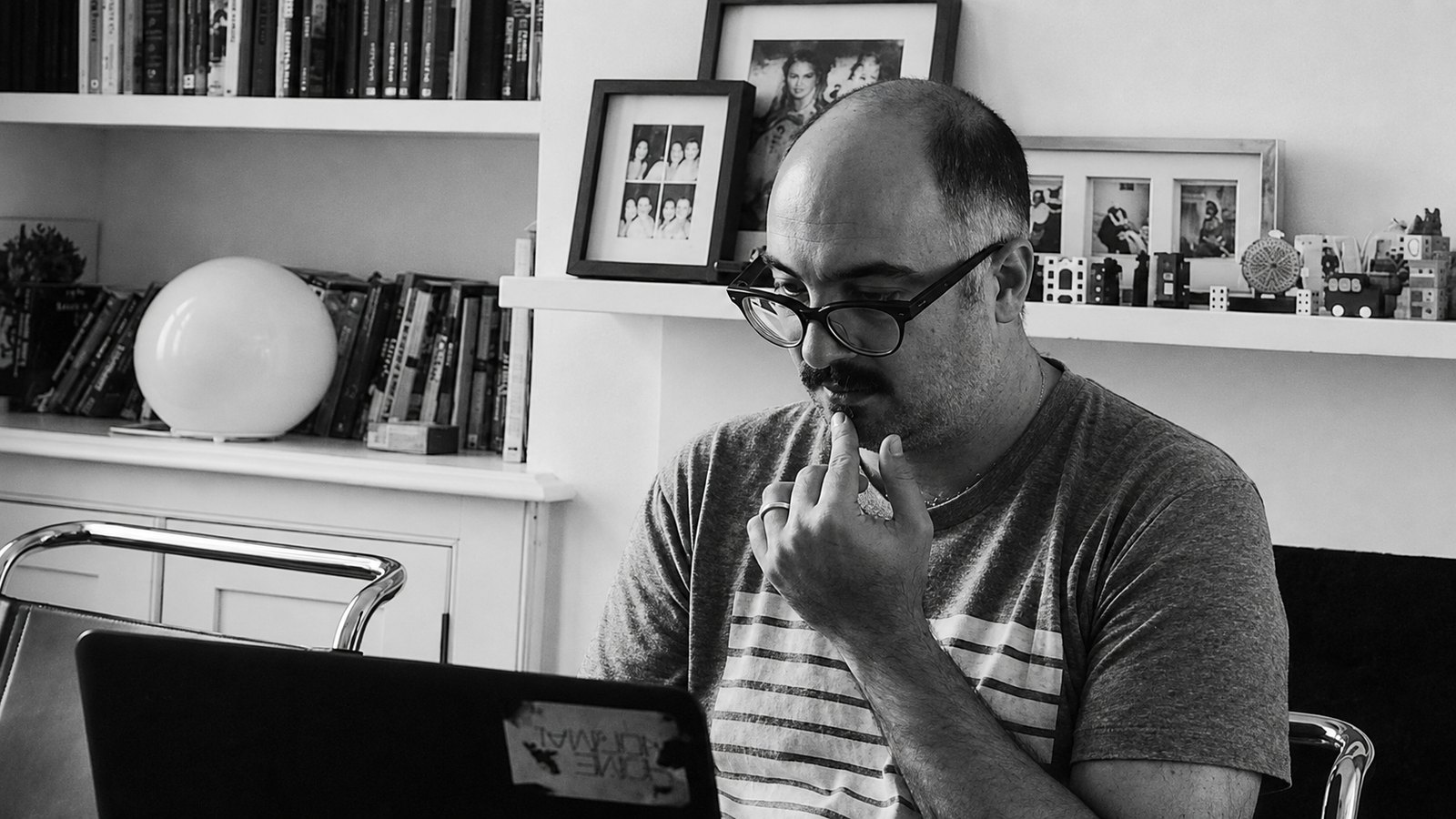
Ian Hawgood’s answers move easily between making a recording and making sure somebody receives it. In this August 2013 interview, the composer and Home Normal curator discusses damaged tape, emotional honesty, mastering, postage and the choices that keep an independent label going.
The conversation also captures his experience of living between Japan and the UK. His descriptions of those places, and the releases he calls forthcoming, belong to 2013. The complete interview is followed by a new editorial note on Home Normal in 2026.
Introduction and archive edition by Justinas Mikulskis.
In this conversation
01 / ConversationA life measured in sound
Ian Hawgood in 113 words.
I live in Japan. My wife, pets and I live by a river in Tokyo, in an area called Nakajuku. I run the Home Normal, Nomadic Kids Republic, and Koen Music labels, plus am involved with a few others on the sly. I make music under my own name, but also under secret monikers, like to build my own gear and wire stuff up, and collect all sorts of musical objects. I'm a high school and university teacher / lecturer, as well as a sound engineer. I come from Oxford, although my family originally comes from Manchester and London. I'm incredibly anti-social but make a good game of it when I have to.
Could you say that you are successful musician? How would you rate your musical achievements?
How does one define success? When I made music just six years ago, I made it without any agenda... just because I had to. It was who I was. That hasn't changed, but maybe the way I view the end work as a whole has. It is less about personal feeling and more about communicating with others in a way. Or better yet, communicating something deep within, so that it transcends one's self and becomes a kind of communication of spirit that is mobile through the very language of music. So to make music, if it means something to you, then it is successful. If you release music beyond to people, who aren't your friends for example, then success should be defined as how well the work communicates with others. I don't mean how many people pick it up (which is the typical and bullshit way we judge 'success'), but to what level. Does it mean something? Does it move them? My last two records have been successful in my eyes in both senses. Have they sold a crap-load? No. But have people responded to them in a deep way...yes. That's success for me.
How did you develop your taste and inspirations?
I had hearing problems as a kid, so I didn't really hear a record properly until I was about 11. That didn't stop my family from singing praise songs around the piano and listening to classical music on record every night. My first cassette was 'Off The Wall' by Michael Jackson. I listened to that and 'Bad', plus some P.M.Dawn and a 'Now' (7 I think) compilation until I was 15 years old. When I was fifteen I sort of fell into the indie crowd (there were two of us), and got into local bands like Radiohead, Ride, stuff like that. At sixteen I discovered an N.W.A cassette in the school field and started listening to hip-hop and rap. At the same time I randomly came across Lawnmower Deth in a record store one day, and got really into a lot of thrash like Xentrix, Anvil Bitch...I can't remember the names now, but I was really into that and hip-hop for like a year or so. I actually got bullied for listening to them! Once I changed schools I joined another indie crowd (again there were just two of us) and we soon moved from PWEI and Inspiral Carpets, and started listening to Warp and Aphex a lot. Then on my gap year a friend introduced me to Eno and it sort of changed my life really. Budd, Eno, Nick Drake, Miles Davis, John Coltrane and BOC became the music I obsessively listened to on my travels (and I travelled a lot during and just after university). I think by this moment I'd had a good three years of musical development and my interests, as diverse as they have always been, took off from there.
02 / ConversationTape, accident and intention
Do you follow the latest musical production and hardware technologies?
Not religiously, but I am a gear nut to be honest. I mean, I read up about a lot of stuff, but I am also constantly educating myself in old technology as that is more my area. I fix old tape machines and buy old broken keyboards to either fix or bend, plus I make different instruments both electronic and acoustic, so a lot of my time is filled with that.
Can you describe from beginning to end how the material - let's say a new album - is made? Describe where the sound concept comes from, what influenced you, how you decided on the timbre or modulations or mood, how it was developed and expanded?
It depends on the album, or work. I mean, I have a lot of gear and my set-up is always changing, so its really hard to describe this concisely. However, I usually kick off with sketches on a four track cassette recorder or a two track reel-to-reel. I went through a patch, where I recorded straight into laptop, but it didn't work for me...I just found it very unnatural. I then edit these by transferring parts onto one of my larger reels as the sound is just so warm and fuzzy. I'll then process from there, sometimes through a computer, or layering through some outboard gear to touch things up as I see fit. That's it in a nutshell.
One thing across all my work is that I hate things being too clean or crisp, so I prefer using analog gear as convoluted as that might sound. At each part of the chain I am into pretty old, warbly gear. I've actually travelled around a lot to pick stuff up that I might use one sound on a record for, or that has a function or tone that I like and need for a record. I just need a bit of dirt and grime to my music, and knowing and using older, slightly banged-up gear helps.
“The meaningfulness comes from the simple fact that the music is an extension of me, who I am and what drives me.”
03 / ConversationWhat gives a recording value
What makes your work as an artist meaningful?
Music is always (hopefully) meaningful to an artist on a personal level. The meaningfulness comes from the simple fact that the music is an extension of me, who I am and what drives me. What makes it meaningful to others, I think, is the fact that I put everything into the record, not just a spiritual self, or base self, but thought into the whole. I think people get a lot out of that and why my last couple of records seem to be lasting time and again with people, which is nice. On another level, and the reason why one goes public, I suppose, is that you connect to a person, people, on a very deep level, only through the language of music. It is a spiritual contact, no matter what the genre, and that makes it incredibly meaningful.
How important is a sound quality to you as a producer, label manager and as a listener?
That's a bit of a double-edged sword really. If I say 'very' then it seems like I don't listen to grimy, filthy music, but need to hear things crystal clear. But still, I have to answer 'very important'. If I hear something which doesn't feel organic, or natural, I just switch right off as its not who I am. So its important, very, but by 'quality' I don't mean something clear as day, I mean something which has been made thoughtfully and has depth. It can be a muddy recording for all I care, but if it works and is whole, natural, then great. This is the same for me as a label owner, producer and listener.
04 / ConversationThe work of an independent label
What is the creative concept behind Home Normal, Nomadic Kids Republic and Tokyo Droning labels you manage?
On a very basic level, Home Normal is about organic, soulful music. I set the label up with a focus on artists, who let the music and beautiful, minimal photography and design, do the talking. It is slowly evolving with more of a focus on film works, and quite a lot of noise and minimal south-east Asian influences coming on board for next year.
Nomadic Kids Republic is more focused (now at least) on electronic works. It has a whole new team running things, so I am left to curate from distance really. It has been on hiatus since September but will be back after the summer with some amazing releases. Each record comes as a double package with live works and remixes added, and we are working with some awesome Japanese designers on these.
Tokyo Droning was focused on more experimental (for want of a better word) outings by Home Normal artists, such as live shows and installation work. However, Tokyo Droning as it was is now basically closed. It has evolved into something else which is still a ways off, but we were forced to stop the original label as we used locally made paper, but they eventually went broke after the earthquake as the company were from Fukushima. Still, it'll be back in a different form and with a different team next year sometime.
Finally, Koen Music (KOMU), is my own small imprint for works I feel I don't want to attach to the labels. I like to keep my own works and collaborations separate now, so this is a home for them. Our first few releases were The Shattered Light, Wolven (which was a split with Hibernate), and 'Sparks' by The Black Elk Quartet (w/ Tim Martin, Clem Leek, and Danny Norbury). KOMU has done really well and I am really proud of the work we have put out, and are about to put out later in the year.
Considering sale price and the record preparing process (mastering, design, marketing etc.), what balance have you found between these two variables in order to give value to your label releases?
In the modern market? With the postage costs of today? Putting out music I genuinely believe in hand on heart and not being swayed by what's 'in'? There isn't a balance really. Postage has gone up so much we actually lose on distribution now and only make back the balance of that through the Japanese market, store sales and digital. I'm a mastering engineer by trade, so I master most of the works, but sometimes I just don't have the time, but that cuts out some of the cost. We do market more digitally now as its easier, but many reviewers still ask for a physical copy which is incredibly expensive. So in terms of balance, its impossible really, especially if you want to provide something which is affordable to your customers/fans. Huge labels with huge distributors who stamp all over the little guys are just about ok, but us little guys... we have to work damn hard to just pretend there is any balance at all.
05 / ConversationBetween places
In your opinion, what parts of the world today are the most fertile in terms of development and growth of new musicians? Why you think so?
For all appearances, Japan for sure. They support Japanese artists a lot Here, which is really great, but its also typical of a protectionist mentality here. However, if you are a new artist, it is probably one of the few countries in the world, where you will get amazing backing compared to most other countries where new artists have a really hard time breaking in so they are recognised. But it also means a lot of crap comes out and is promoted just because of an artist's nationality, and especially if they are mates with someone who is 'in'. That creates a stagnant scene, and in a country where people are so loyal with their record buying, that's a really bad move, in my opinion. So Japan is really good on the surface for new artists, but for new music and evolution - no. That's just not really something that happens here sadly. Saying that, when it works, it really works. It is wonderful to see a stand and posters for these new artists in somewhere like Tower Records in Shibuya, where in other countries people wouldn't even try to stock it. So that's a good side of it.
If you want something genuinely new and interesting, the best places right now (for me), are south east Asia, India, parts of Africa, and Indonesia especially. I've seen and heard incredible underground music in Indonesia, and India especially. Totally earthy, wild, and unique. There is so much good music there in the local scenes, and the kids really know their stuff as well. We've had a lot of incredible demos from kids, not more than 18 years old some of them, that are so free and unhindered from scenes and music politics. I think its simply down to the right amount of wildness in the local communities. It is a kind of wildness we in Britain had a while back, but which has died out a bit as life is just too easy now. You've got to blame Labour for that though. Thatcherism had its perks after all. You need a bit of wild, a bit of anger, a bit of edge, to create music which is really something. Our growing need for something immediate has ruined that a bit. But in countries where kids don't necessarily have laptops as a given, or have Facebook and other social media on all the damn time, when things are a bit more old school, things get interesting.
There is one other place that I know of where there is sort of a mini-scene happening in terms of very organic, instrumental, unique minimal works: Italy. I have no idea why though. I lived there for a while and the music I came across was just awful. But in the past couple of years there have been a growing number of artists doing remarkable things there. Maybe its something to do with the heat because many are from the south (where I lived...Puglia)! I don't know. But something is going on there and its great. Giulio Aldinucci is probably at the head of the class right now. I am biased, but the guy should be regarded as a national treasure...he's that good.
Can you elaborate your insights about the essential differences between London and Tokyo ambient music scenes?
I think both countries are so small we can just stick to Japan and the UK, rather than the capitals. The UK certainly had a 'scene' for a couple of years with Home Normal, Hibernate, Under The Spire etc a while back. UK stores loved the scene, but it was total bullshit really as Home Normal for example, was never an ambient label. They just used that to sell records. Such genre definitions are supposed to make buying music clearer, or quicker even. The problem with scenes is they need these definitions for the sell, but the end result is that it limits labels and artists. The follow-up issue then is that the market gets flooded, and people who don't really care about music, which is perhaps a bit too 'quiet' for their attention spans, mix absolute crap with brilliant new music as they can't tell the difference. They are there trying to promote music (actually its themselves) or sell it, but they have no clue about what real, thoughtful, slowly evolving music is.
So right now the 'scene' so called is dead, but only as a 'scene'. The music is as vibrant, possibly more so, than it ever was, because the influence is now filtering through. But there is seemingly no support for it now as the stores and magazines (the scene 'setters') have moved on. However, the stupid thing is there was never really much of a scene. People still follow beautiful music. If something is made right, people will still somehow find it and take it on board. The 'setters' miss that, and set nothing. Its the way of things, especially in the UK, and its rather silly really, but it'll come around again as it always does.
Japan is different because there was never really a noted 'scene', but the artists who were popular before things kicked on in the UK (and USA / Europe for that matter), are still popular now. Nothing has changed, but herein lies the problem. There are a handful who all support each other which is nice, but its a small group who never support new artists unless they are friends. The same people play the same shows over and over, and its a little bit boring really. I found myself in that a few years ago, but got totally sick of it, and once we moved out into the sticks, I just happily left that behind.
So the difference is that there is very good support for ambient artists in Japan, if they are connected in the right way only though. But the music as a result of this, is a little bit limited, uninspired on the whole, for my tastes. In the UK though, I think the result of a lack of support will actually revive the music side of things. Scenes ruin the music they are supposed to be promoting and celebrating, period. A certain distributor or webzine etc will make the same comment about the (amazing) music of Taylor Deupree, for example, and someone, who has fallen asleep on their keyboard, recorded it, and claimed it as 'drone' music. They will call it 'fluffy pillow music', missing the depth of the former entirely. People aren't stupid and realise that the person they have promoted is talentless, but then switch off the scene as they blame that rather than the fact that they trusted a store who is only interested in money.
Essentially, people who deal in music need to understand that a Romeo and Juliet is not the same as a Mills and Boon. They might be about love, but they need to read the book to understand the contents and depth of what's inside. It is an inherent problem with the music we make; that it takes time to listen, that you can't capture it in a press blurb and a 30 second clip. The one good thing about this is that when the scenes fade, the people who shouldn't even be in the same vicinity go onto the 'in' genre and the true artists shine through again, a scene restarts to sell records, and so it goes on and on in a cyclical fashion. Which is better? The limited but solid path, or the cyclical spurts of brilliance? They both have their flaws of course, but its the way of things.
If you weren't in music industry, what would you like to be and why?
A farmer with a porch and instruments everywhere (which isn't far off actually). Pretty much who I am now, only probably slightly further down the line and just sending tapes to friends of my music.
06 / ConversationPlans, people and happiness
What exciting projects, performances or releases await in the near future? Could you present them in depth for our curious readers?
Wow, ok, well I didn't release anything for ages but have been working on a bunch of stuff with friends for years. They are all about ready now so this year to next will be kind of flooded with these great projects years in the making. So here's a list to make things a little easier:
- Lantscap is the moniker for my work with Warren Kroll (Forrest) and we completed out debut 'Varying Degrees of Alive' a couple of years ago now. It'll be out on the awesome Infraction label on vinyl in the next couple of months. Its mostly guitar stomping ambient, with some very pretty little twists along the way.
- Rion is a collaboration with an old friend of mine, Ryo Nakata. Our debut 'Fireflies' will be out on Hibernate just after the summer. We spent an age working on the record and its sort of a nice guitar drone with wheezy organ, bells, vibraphone, harmonium etc record. We called it the new Vincent Gallo record, without Vincent Gallo if that is any indication.
- The Whalers Collective is a group consisting of myself and Gareth Davis, with Ryo again, Felicia Atkinson, and Rie Mitsutake. The album was made a few years ago now, but we found ourselves playing around with it for a while. John Twells mastered it a few months ago and did an amazing job. Its a pretty wild drone record, with Gareth on bass and contrabass clarinet, myself on gamelan, double bass and tapes, Rie on vox, Ryo on guitar, and Felicia on ukelele and vox as well...probably the record I've been involved in that I've listened to the most.
- Spent the past three plus years working on the new Koen Park material when I swore I would close down the moniker. I kept getting invited to release more music as I just stopped after the success of the Experimedia release, but eventually decided to work on more electronic-type work again. Probably won't be under the old moniker though but will be out on two amazing labels (secret for now I am afraid) next year.
- My old mate Tim Martin (Maps and Diagrams) and I are finishing up the new Black Elk Quartet record which has taken longer than expected. 'Anchor' should be out before the end of the year. We're also working on a very secretive series of albums (the first of which is complete and will be out in the next couple of months) which focus on decayed tape recordings and sound incredible. Totally different work for us and really very proud of this indeed.
- Taylor Deupree just sent over the final masters for a project called 'Tiny Isles' which has been on the go for about 4 years. It started as a project between Christopher Hipgrave and myself, but then opened up to include Jason Corder, with the help of Antony Harrison, Ben Chatwin, Rie Mitsutake, and Erik Schoster. The album will be out in August on Koen Music.
- Talking of Jason Corder - our Kinder Scout project (with Danny Norbury) will go live at the HomeNormalism festival in August in London. Its going to be incredible and the new work is so so good, if I do say so myself. The festival will see audio/visual performances from offthesky and Orla Wren (who will also release his new album and dvd on the day), with Fabio Orsi, Wil Bolton, Pillowdiver, Isnaj Dui, Astrid, Stefano Guzzetti, and Kinder Scout playing, and Paco Sala and Hybernation on DJing duties. Should be an incredible couple of nights in London. I think Kinder Scout will probably be producing an album from the material we've been prepping and on the night.
- Wil Bolton and I are close to finishing our collaboration. We've known each other for years now, so its great to be doing something together. Probably looking at a post-summer release on KOMU.
- Ben Jones (one of my best friends from uni and who helped set-up Home Normal) and I have a new project called Wraith vs Wrath. We have completed a work in a series of ten which will be digitally released every few months on KOMU. The first in the series is called Kex | Lux and will be out on June 7th in digital format only. It was mastered by James Plotkin and sounds great. Its taken us about 12-13 years to make the series as we kept messing around with the tapes and post-recorded reels obsessively. As a result the whole series is quite gritty, muddy work, with lots of crackle and splice cuts across it...which is a good thing!
- James is actually mastering a lot of my old releases which went out in very limited numbers or on netlabels. These will be re-issued over the next year, with the first being 'Wolfskin' on the 30th of June, followed by 'We Are Better For Being Built This Way' on the 14th of July. The rest will be out post-summer.
- Brian Green and I started work on a project called Ghosts In The Alleys (Of Your Heart). James P is just mastering this now and it should be out at the end of August on CD. It started out as simple meditations on singing bowls and violin, but then I started thrashing around on my guitar and running it through reels - so its this incredibly noisy, wild, beautiful beast really.
- Finally, Danny Norbury and I are working on re-edits of my very old Mobeer and U-Cover releases. These were split into two 3" releases but were actually supposed to be part of an album (with another previously unreleased track) which has had the working title of 'Every Solstice, A Fire' for a while. I am not sure when we'll be done with this but its something that I am really excited about finally completing.
So there you go - been a busy few years but everything is just suddenly coming to a head at the same time for one reason or the other.
Are you happy? Maybe you would like to say something important to your family, friends, fans and all die-hard music lovers?
Yeah. Yeah, I really am. None of my friends will read this as they couldn't give a toss about my music, and for that I am thankful. But I would like to say how much I appreciate anyone who picks up any of the stuff I create, or am a small part of...it means so much to me, and has helped me to create, and through creation understand more of who I am which is all anyone can really ask for.
Finding a sustainable rhythm
The most revealing parts of this interview are often practical. Hawgood talks about the effort behind a release, the cost of sending it and the gap between those costs and what a listener can reasonably pay. Those details make his care for music tangible. A label exists through repeated decisions of that kind.
Reading it in 2026, I am drawn to how closely the musician and the publisher depend on one another. His ideas about imperfect recordings belong to the same conversation as his ideas about treating an artist’s work properly. The object matters because someone has put time into it, and because someone else will live with it.
Home Normal has now announced a slower pace after its final year of regular physical releases. Its August 2026 collection the places we carry makes clear that the label and its physical editions will continue. Hawgood has mixed 24 released and forthcoming works into one continuous sequence. The accompanying note describes the practical need to give other parts of life more time.
That makes this a good moment to revisit his earlier answers without treating them as a farewell. The collection’s account of the label’s beginnings also returns to Japan, friendship and the question of what constitutes a home. These are concerns already present in the interview, even as the circumstances around them have changed.
The 2026 edition of 光 / 彼方 offers a parallel return to Hawgood’s own earlier music. An archive can work that way too: bringing something forward because it still has a use, while allowing the person who made it to move on. For me, restoring this conversation means making the work behind the catalogue visible again, including the limits that allow it to continue.
About this archive edition
Originally published on 18 August 2013. The complete questions and answers remain in their original sequence. References to current events, places of residence and forthcoming releases belong to that original date. New chapter headings, an introduction and an editorial afterword by Justinas Mikulskis accompany the historical conversation.
The featured portrait is an AI-assisted restoration and 16:9 crop of the original archive image. Original photographic credits are retained. Embedded players have been replaced by direct listening links where available. Album artwork is reproduced alongside links to the official release pages and their credits.

1 Comment
Thanks for posting this interview. Just picked up 'Fireflies' and loving it.