Swarm Intelligence
ALL VINYL / MATERIAL · BODY · PRESSURE
Two turntables, a mixer and a reverb pedal turn 36 records into a 124-minute pressure system. Noise reveals melody as rhythm gathers weight.
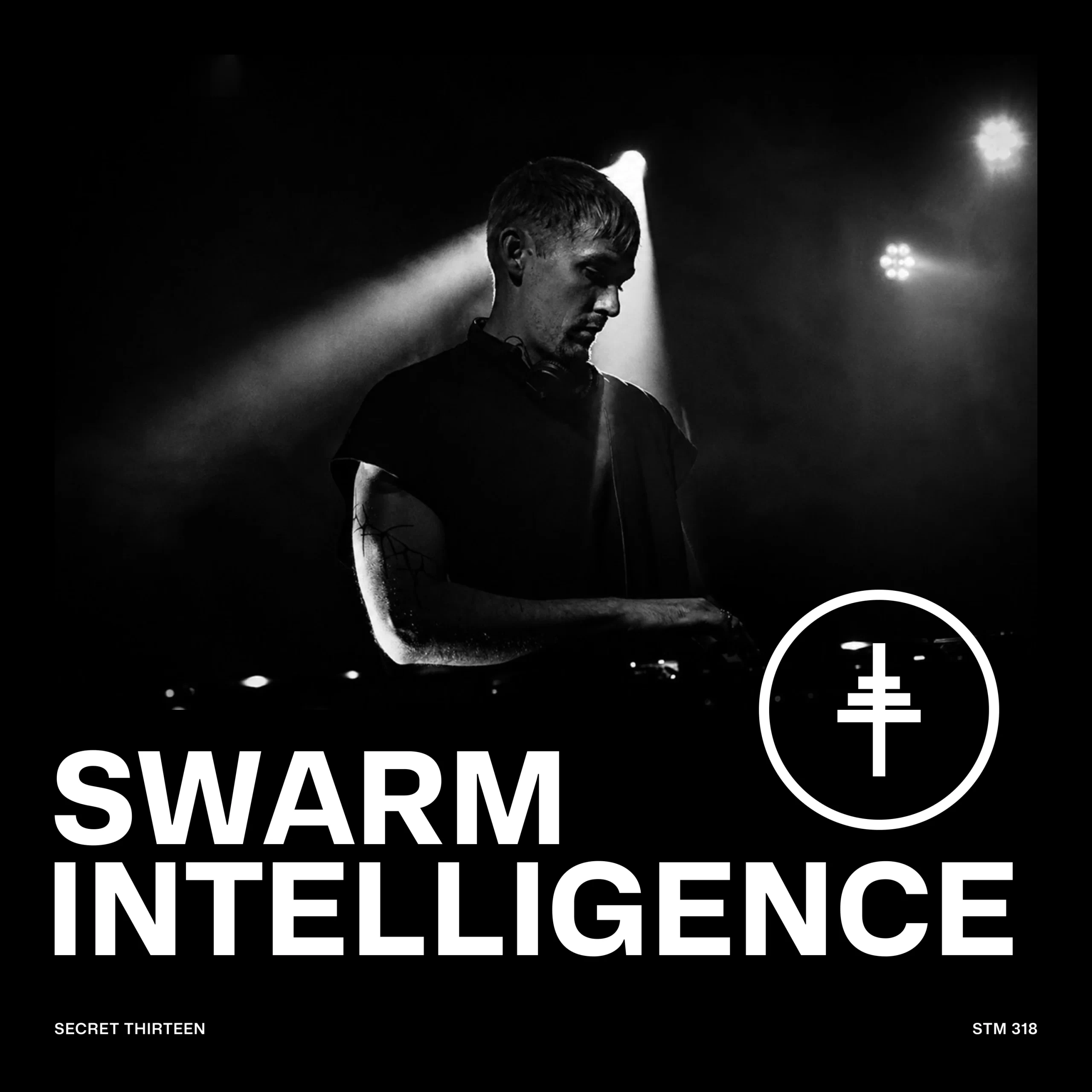
Listen to the mix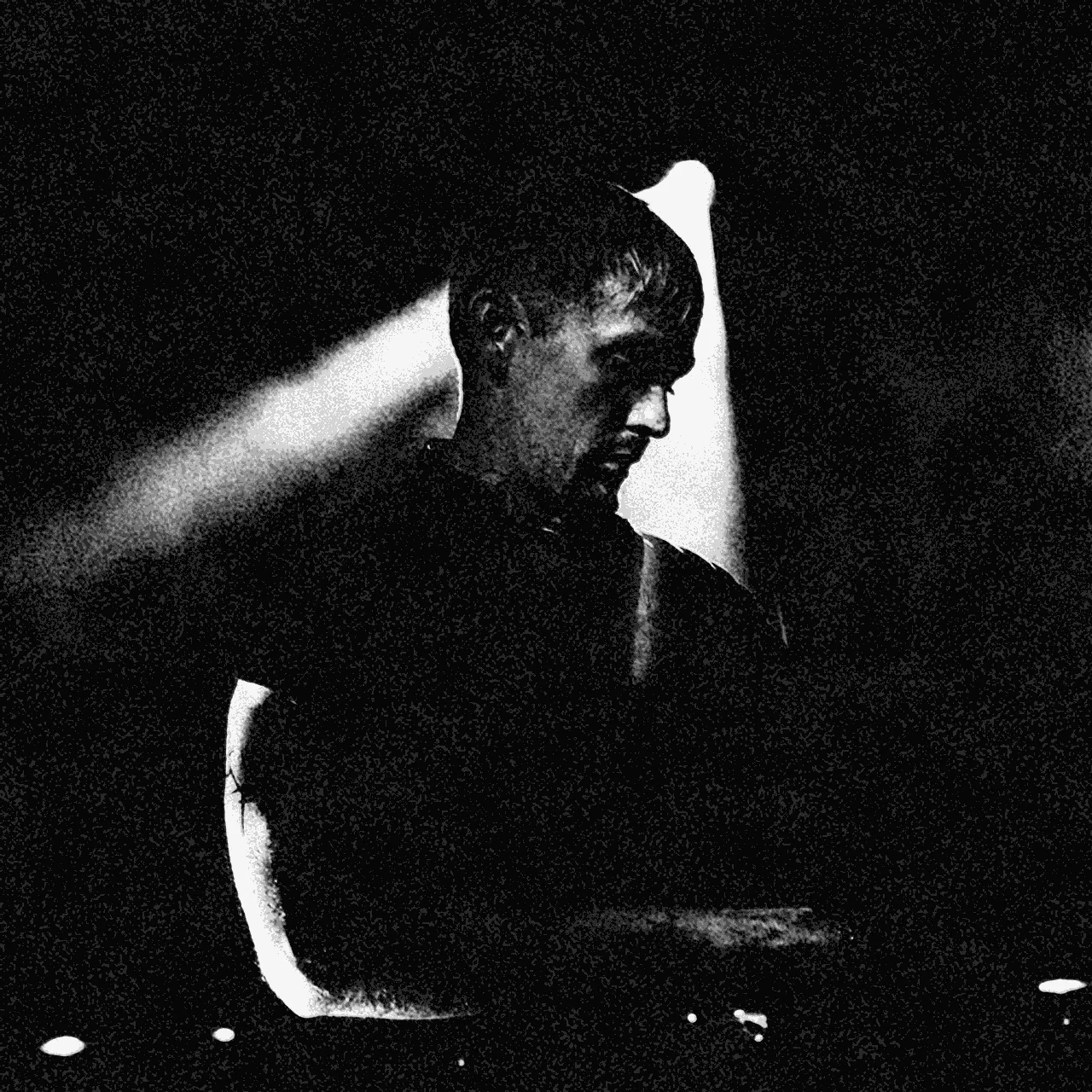 Cover
Cover
Thirty-six tracks occupy two hours and four minutes in Swarm Intelligence’s contribution to Secret Thirteen. The arithmetic gives each title an average of three minutes and twenty-seven seconds, yet nothing about the mix suggests impatience. It reveals something more consequential: overlap is not merely a transition technique here, but the principal compositional material. Records do not queue politely and surrender the room one after another. Their shadows coexist. A resonance introduced by Monolake can remain psychologically active when Xenakis enters. The grain of Merzbow alters how Tim Hecker’s melody is heard, while Kareem’s repeated appearances accumulate into an internal structure long before the final industrial pressure takes hold. What first seems like a formidable tracklist gradually loses its divisions and behaves as one extended work, rising by density, memory and changing physical weight rather than by the blunt administration of tempo.
Building the room
The commission began with Hayes’s response to TRSSX’s STM 314. The invitation that followed asked for something slow, corroded and dungeon-deep, not a snapshot of the moment but a structure capable of surviving it, excavated rather than made. Hayes answered by translating that image into three tensions already embedded in his own production: rhythmic noise against glitch, atonality against cinematic form, and lo-fi sludge against clean precision.
This patience is central to Simon Hayes’s work as Swarm Intelligence. Born in Dublin and based in Berlin since 2009, Hayes came through the gravitational fields of bass music and techno, while studies in engineering and artificial intelligence sharpened an attention to systems, failure and the behaviour of complex signals. The project was conceived partly as an escape from uniform four-to-the-floor logic. Its early recordings used speed, raw distortion and rhythmic noise as tools suited to illegal raves, squats and damaged rooms. The albums Faction and Rust, released by Ad Noiseam in 2014 and 2015, consolidated that language without domesticating it. Later work for Voitax, Instruments of Discipline, Natural Selection and his self-titled Swarm Intelligence imprint did not abandon the original problem. It moved around it, testing how much atmosphere, broken rhythm, bass pressure and cinematic space a harsh sound could contain without becoming illustrative.
The discography therefore makes more sense as an investigation than a stylistic progression. Hayes has sampled scrapyards, abandoned power infrastructure and metal sculpture parks. In the Home Recordings project, coil pickup microphones converted the electromagnetic activity of household appliances into sound. Physical objects enter as evidence, then broken circuits and digital processing push that evidence past recognition. The result is precise but never sterile. His engineering knowledge does not remove dirt from the signal. It makes dirt structurally legible. That same method governs this selection. Rhythmic noise, electroacoustic composition, dub-informed negative space, industrial techno and synthetic melody are not arranged as separate scenes. They are different states of matter subjected to the same pressure.
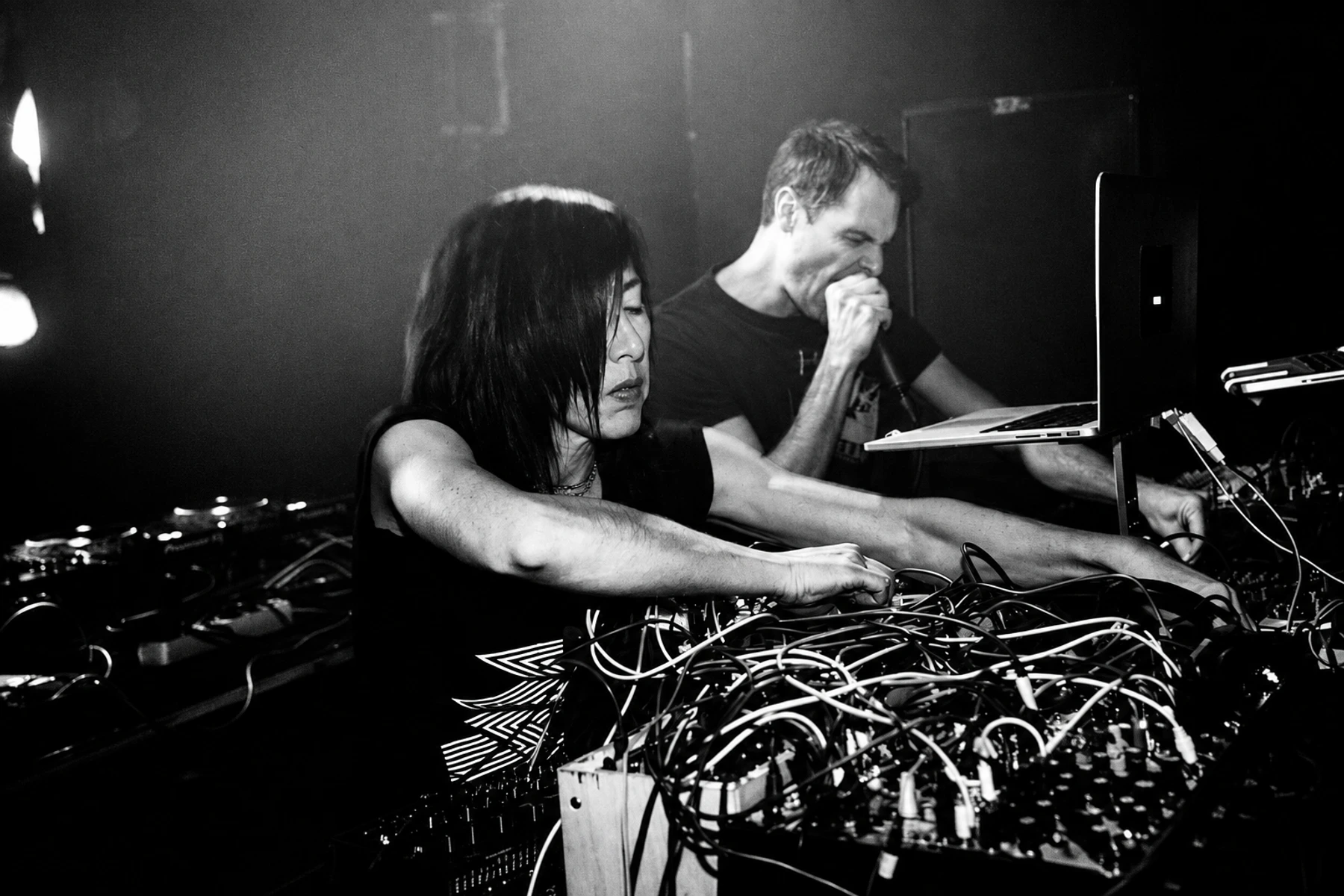
The immediate architectural reference is Kraftwerk Berlin, the former power station where Berlin Atonal resumed in 2013 and where Hayes has repeatedly experienced sound as something larger than a frontal image. Its concrete chambers, extreme reverberation and brutalist scale teach a particular kind of listening. A kick may be a point of impact, but its decay belongs to the building. A drone is not a background, but a volume one enters. Hayes carried that memory into a deliberately restricted setup of two turntables, a mixer and a reverb pedal. No additional production disguises the sources. The pedal does not become an effects arsenal. It acts more like the absent room, extending one record until it contaminates the next and allowing the imagined architecture to function as a third deck.
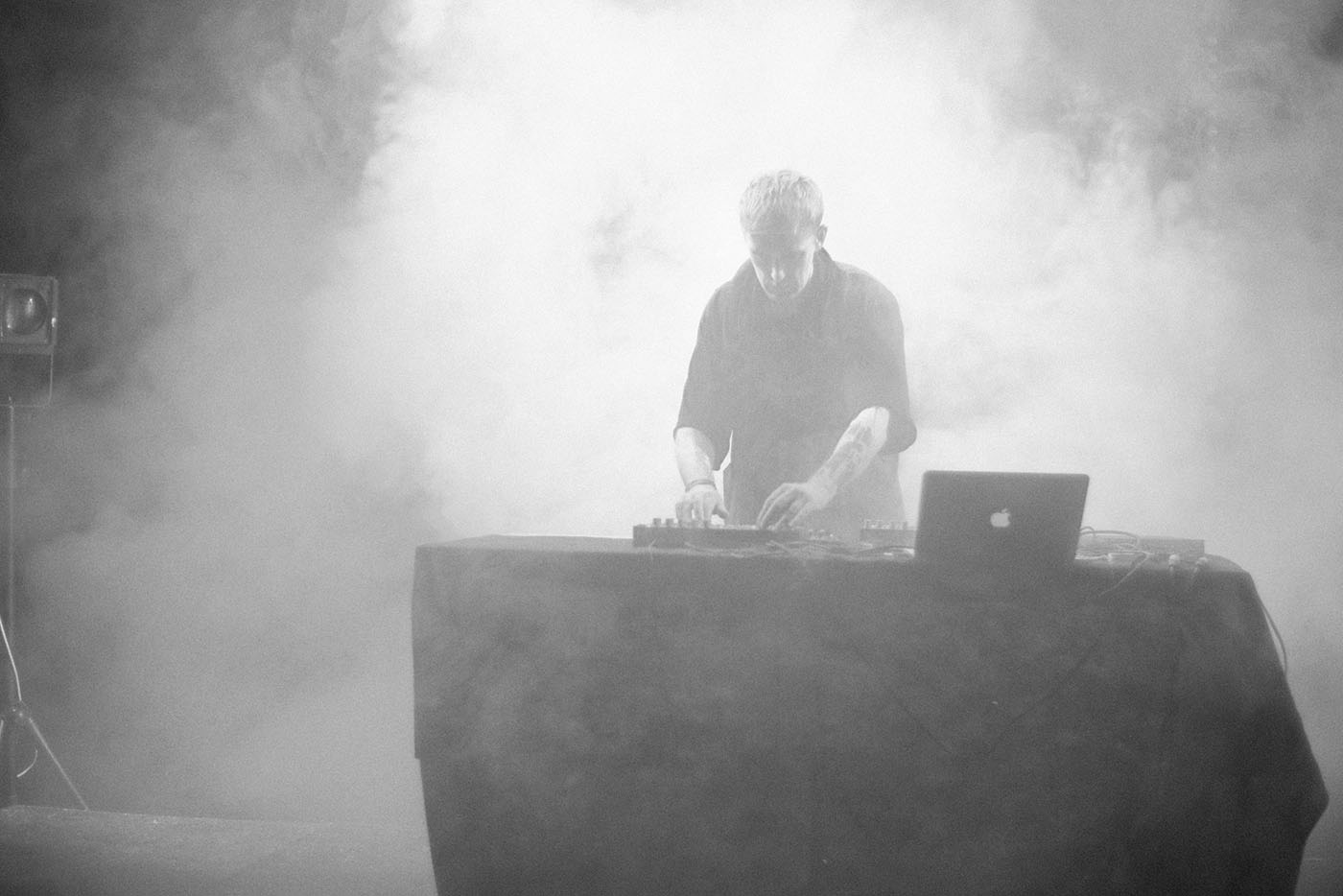
“I played around with the idea of tones and melodies being revealed through, and engulfed in noise, abstract/unsteady rhythms forming and deforming, shifting between solid and foundational to distilled and perceived rather than detected.”
SWARM INTELLIGENCE / ON THE MIX
The decision to work entirely with vinyl gives this proposition another productive contradiction. Much of the music was made through synthesis, digital signal processing, algorithmic procedures or microscopic studio editing, yet it reaches the mix through groove, pressing, cartridge and hand. Technologies designed to exceed the body are returned to a surface that can be touched, worn and misread. The needle adds no romantic guarantee of authenticity. It introduces friction. Against a contemporary assumption that precision requires invisible playback, Hayes makes precision coexist with the small instabilities of a physical carrier. The mix is not nostalgic for records. It needs their resistance.
Material
Monolake’s “Nucleus” is the ideal first excavation. Originally released on Gravity in 2001 and cut to vinyl for the first time by Field Records in 2025, it arrives from an era when dub space, computer music and club function were being recombined with extraordinary economy. Robert Henke and Gerhard Behles built Monolake’s early language from exacting digital processes, but “Nucleus” feels less like a demonstration of software than a chamber whose dimensions are inferred from reflection. Beginning with it establishes the mix’s governing scale. The listener is not given a beat to follow so much as a volume to measure.
Karim Maas’s “Lizzard King” corrodes that clean negative space. The bass remains architectural, but its edges splinter and circuitry appears to strain against the grid. Aho Ssan and Resina’s “Egress II,” from their 2025 collaboration Ego Death, then converts the fracture into dialogue. Aho Ssan’s digitally generated masses and Resina’s cello-derived pressure refuse the old separation between electronic and acoustic source. Their collaboration, developed after an encounter around Nicolás Jaar’s Weavings project and brought into physical form at Unsound, hears the string not as organic consolation but as another body capable of abrasion. At this early point the sequence has already moved from simulated room, to faulty mechanism, to instrumental matter without breaking its depth plane.
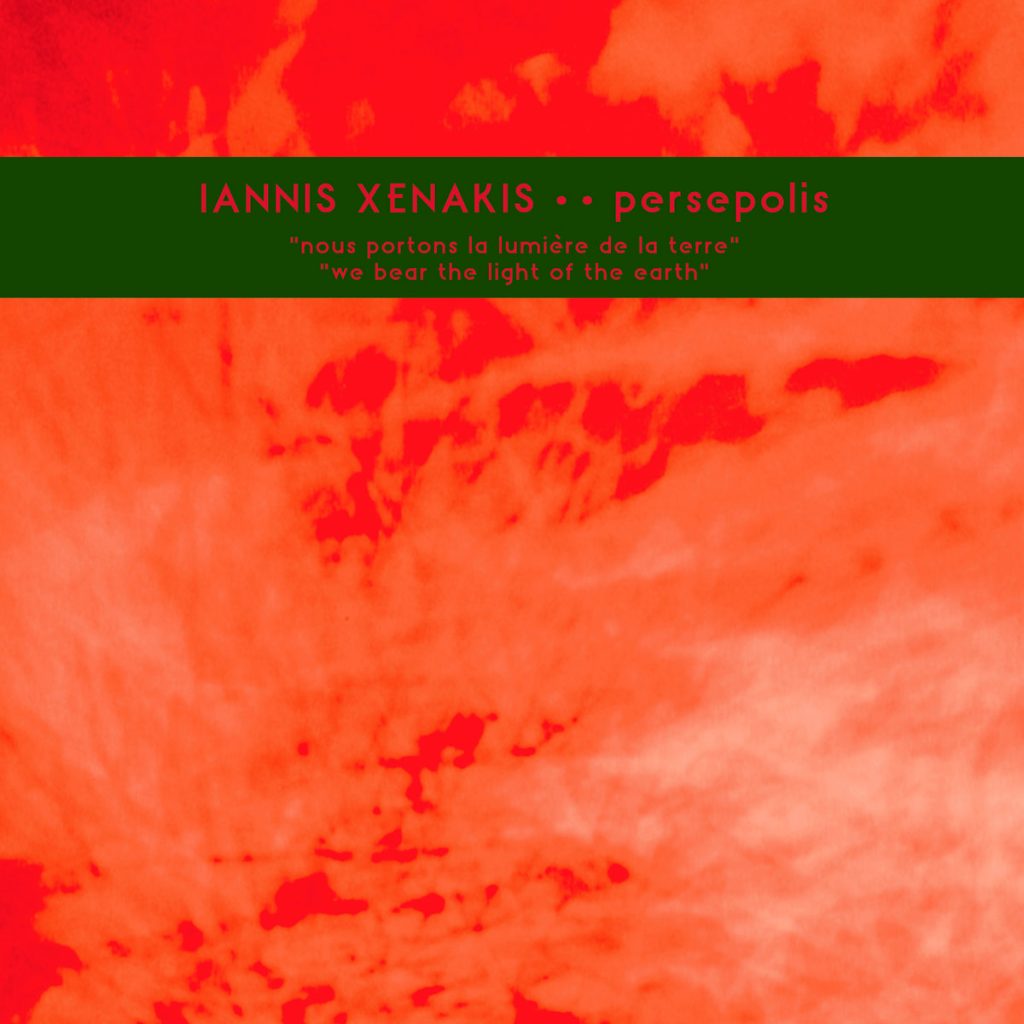
Lakker’s “Eris Pt. 2” supplies a conceptual key. Eris Harmonia joins the Greek figures of discord and concord in one title, and the second part allows bitter harmonic colour to emerge from the atonal pressure established by the first. Hayes does not play the opposition as a neat reconciliation. He uses the record to make harmony feel conditional, a temporary pattern inside instability. Iannis Xenakis’s “Persepolis (Part 1)” enlarges that condition to monumental scale. Composed in 1971 for the ruins of Persepolis and originally diffused from eight-track tape through fifty-nine loudspeakers among light, lasers and processional fire, the work treated landscape, architecture and sound as inseparable forces. The Karlrecords edition places this historic mass on contemporary vinyl, but the piece still refuses to behave as an object. Even in stereo, it sounds like an event too large for its container.
In the records


Xenakis is not inserted as an academic credential. He is an ancestor of the mix’s physical thinking. His densities make individual causes difficult to isolate, and that uncertainty passes naturally into Cevdet Erek’s “El-Fokurtu,” created for Emin Alper’s film Frenzy. Erek deformed the sound of a helicopter until the machine suggested a bubbling, percussive organism. Source becomes rhythm through pressure rather than through illustration. Merzbow’s “Torus 2” pushes the same transformation toward saturation, while Yair Elazar Glotman’s “Oratio Continua (Part I)” reverses the direction. A trained contrabassist, Glotman built Études by interrupting learned technique and searching the instrument for resonances that virtuosity normally suppresses. Merzbow seems to erase the source through excess. Glotman reveals it by unlearning control. In Hayes’s continuum, these are complementary operations.
This passage also exposes the importance of Subtext Recordings. Aho Ssan and Resina, Erek, Glotman and, shortly afterward, FIS do not form a house style, but they share an understanding of sound as material research. Tim Hecker’s “Keyed Out,” placed between Glotman and FIS, briefly opens a luminous wound in that research. On Konoyo, recorded with members of the Tokyo Gakuso gagaku ensemble in a Japanese temple, Hecker resisted the impulse to bury every space under layers. “Keyed Out” lets a deteriorating synthesizer line and the small gravity of court instruments expose one another. Melody is present, but its presence is precarious. It is precisely the image Hayes described: tone visible behind a wall that may close again.
In the records
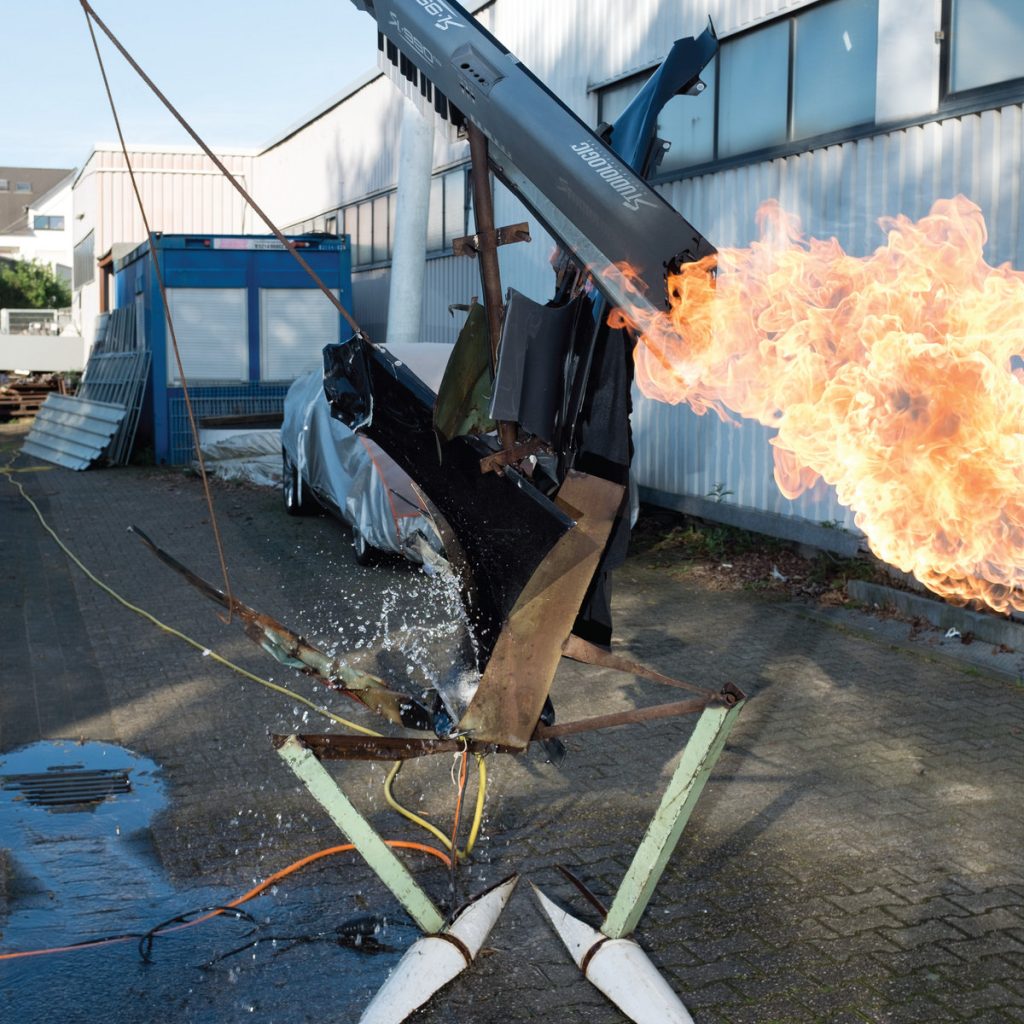
FIS’s “SeaPR” and Kevin Drumm’s “Impotent Hummer” make that wall porous in different ways. Oliver Peryman’s work as FIS emerged from drum and bass but increasingly replaced genre syntax with structures closer to ecology, pattern formation and environmental systems. His parallel engagement with permaculture is not a decorative biographical fact, because the music repeatedly asks how small relations produce complex wholes. Drumm, by contrast, can reduce the same question to unbearable voltage. “Impotent Hummer,” issued with Editions Mego’s edition of Sheer Hellish Miasma, belongs to the period around that 2002 landmark, where guitar, electronics and processing ceased to be separable identities. Together the two tracks show why this opening movement cannot simply be called ambient. It is a chamber under active construction, its surfaces continually grown, scraped and rebuilt.

Body
Glen of the Downs’ “Incident,” one of the newest records in the set, and Dot Product’s “Atmosphere Processor” begin to give that chamber a mechanism. The former arrives from Fran Hartnett’s Scart label in 2026 with a title that suggests a discrete rupture. The latter, released by Osiris Music a decade earlier, names the operation more literally. Yet Hayes avoids the obvious chronology of innovation. A piece from 2026 does not represent the present while an older record supplies heritage. Each is selected for function. “Incident” introduces a disturbance, while “Atmosphere Processor” turns atmosphere from mood into apparatus. Oneohtrix Point Never’s “Chrome Country” then produces the first unmistakable horizon, its synthetic choir and organ-like glow closing R Plus Seven with an artificial grandeur that is moving precisely because its humanity cannot be located.
ASDA’s “Lungs Full and Heavy” refuses to let that horizon become transcendence. Sebastian Gainsborough and Chester Giles bring the voice back as weight, breath and damaged social presence, their No Corner language drawing dub, noise, poetry and low-frequency pressure into the same gutter. The title is almost physiological instruction. After the disembodied sheen of “Chrome Country,” lungs reappear, but breathing is difficult. This is the threshold on which the mix begins to acquire a body.
Vit Fana’s “Fasad,” Torus’s “Omnia” and LFO’s “Blown” do not suddenly announce a dance-floor section. They allow rhythm to become incrementally more accountable. “Fasad,” from Northern Electronics’ 2016 album Irrgang, belongs to Ossian Ohlsson’s world of corroded percussion and obscured form, connected through Body Sculptures to the wider Scandinavian industrial network. Torus approaches the body from the opposite direction, using bass and spatial design with polished but unstable clarity. Then Mark Bell’s LFO places both impulses inside “Blown,” the 2003 opener to Sheath, where brittle impact and symphonic atmosphere can occupy the same compact machine. The three records define a gradient, not a switch: façade, totality, detonation.
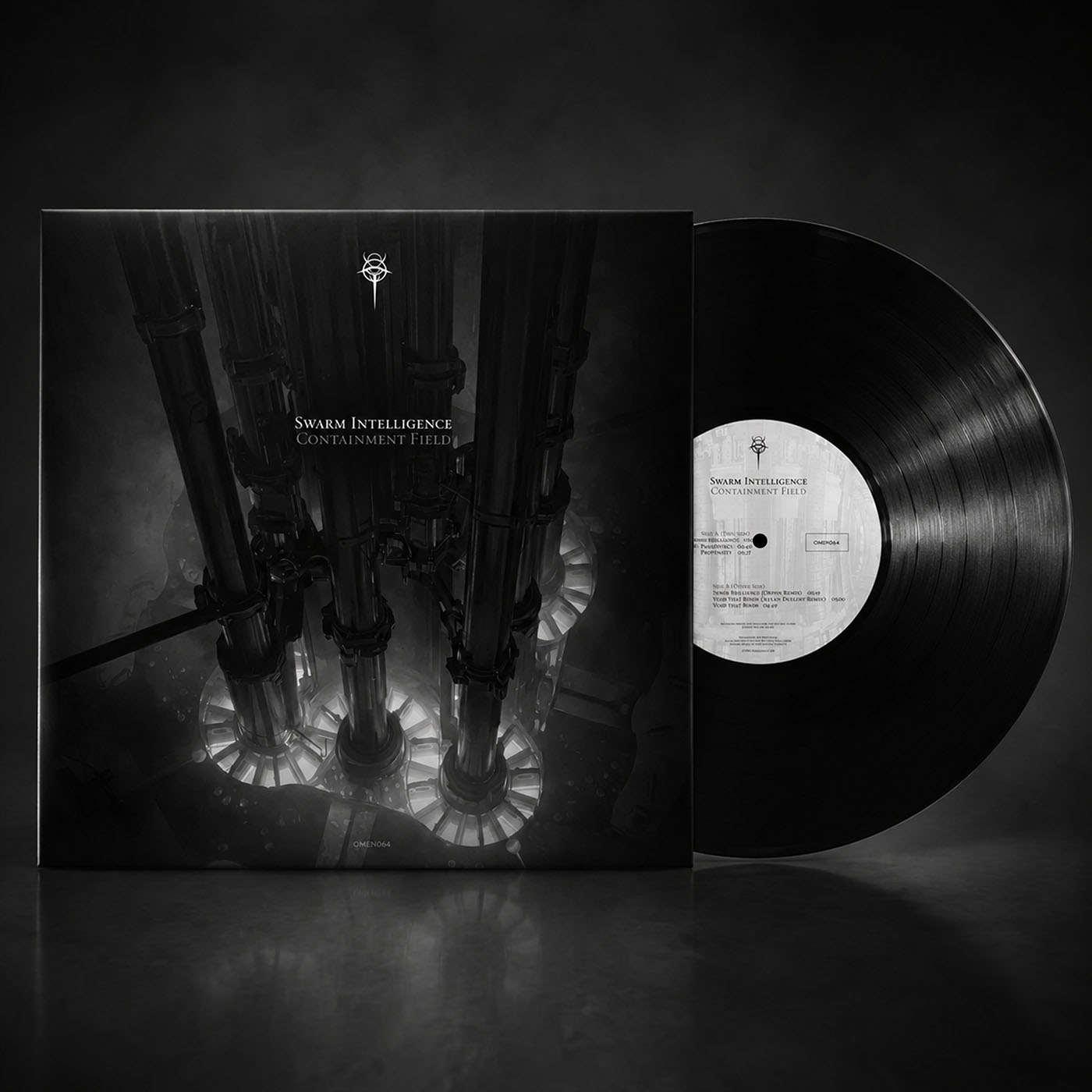
The same tension remains active in Hayes’s own current work. Released by Omen Recordings in June 2026, Containment Field presents new material alongside remixes by Orphx and label heads AXKAN and Duellist. Its run of one hundred vinyl copies is pertinent here as a recent physical continuation of the same method the mix extends across other people’s records: brutal pressure and exact movement pressed into a surface that can wear.
Pressure
Mannerfelt & Haydo’s “Stepping In” begins the central axis of Avian and Zhark, the two label systems that give the second half its skeletal strength. Radio Mohave fractures percussion into polyrhythmic, greyscale signals. Kareem’s “Radujew,” from the 2000 release Schattenreich, answers with a much older form of industrial severity that still sounds temporally displaced. Olga+Jozef’s untitled OJ-06 cut and Sigha’s “Loop Three” continue the displacement. A Slovak record from the turn of the millennium and an Avian release from 2014 meet not because their surfaces match, but because both understand reduction as pressure. Repetition removes explanatory detail until the remaining event — strike, gap, return — feels ritualistic.
Kareem appears three times across the mix, more than any other artist, and the recurrence is decisive. “Radujew,” “Druids” and “Hinrich” stretch from 2000 through 2003 to 2018. Harsh’s “Scharal,” from the Tripods EP, belongs to the same Zhark continuum without sharing Kareem’s authorship. These are not retrospective signposts placed to certify an industrial lineage. They act as load-bearing walls. Each Kareem return makes the surrounding record sound more severe and also more spacious. Zhark’s work has long occupied the disputed territory between techno, noise, ritual and political unease, and Hayes treats that territory as a durable construction rather than a genre prehistory.
The relationship also folds back into the Secret Thirteen archive. Kareem’s STM 264 included Swarm Intelligence’s “Antenna.” Here Hayes reverses the direction and uses Kareem’s records as internal reinforcement. It is a small but telling circuit. An archive of mixes is not only a shelf of completed statements. Artists continue to hear, quote and reorganise one another across it. In this case, the quotation does not occur through sampling. It happens through placement and duration.
Antechamber’s “Lobs Pound” makes the body stagger before Kareem’s “Druids” restores a darker ceremonial gait. The Antechamber project, involving Mahk Rumbae of Konstruktivists and Codex Empire, treats industrial rhythm as a ghost architecture, with dub-like voids around objects that lurch rather than lock. “Druids” turns those voids into a site of assembly. By now Hayes has not increased intensity in the conventional sense so much as increased consequence. Earlier sounds could be perceived as weather. These sounds imply bodies forced to negotiate them.
Reeko’s “El Libro Secreto De Gala” opens the final movement with disciplined opacity. Lumisokea’s “Raid” follows by troubling the grid through analogue hardware, reel-to-reel saturation and rhythmic ideas informed by South Indian classical music. The duo’s Apophenia is aptly named: it concerns the mind’s impulse to perceive connections, and here those connections become real through mixing. Ueno Masaaki’s “Vortex State” converts them into a model of natural law. On Vortices, Ueno did not attempt to imitate natural phenomena so much as reconstruct their principles through chains of expansion and contraction. Hayes uses that rotational logic to prepare the set’s most compressed sequence. The climax begins as a change in how energy circulates, not as an abrupt rise in level.
At track twenty-eight, Harsh’s “Scharal,” from the 2001 Zhark EP Tripods, reveals that the label’s spine is wider than Kareem himself. It leads directly to “Hinrich,” allowing two decades of the same practice to touch without a historical caption. D.Å.R.F.D.H.S.’s “Bensin I Storkågeträsk” then infects that austerity with the peculiar emotional corrosion of Northern Electronics, where synth colour can resemble both memory and chemical residue.
ANFS’s “Dervisis” leaves cavities inside its broken kick pattern. Michal Jablonski’s “Wrath” and Sigha’s “04” reduce those cavities while preserving their instability, so the final acceleration never hardens into a standard run of functional techno. This is where the difficulty of Hayes’s pacing becomes clearest. With thirty-six tracks available, it would have been easy to prove range through constant interruption. Instead he makes density cumulative. Earlier electroacoustic grain remains conceptually present inside the kick, and the memory of the first hour prevents every later loop from becoming merely efficient.
The last three records deny a clean catharsis. On Huren presents MRTVI’s “Partial Deletions,” David Foster’s scorched industrial method enters the sequence as damaged information. Death Qualia’s “Kore Abduction” introduces a violent, post-industrial mutation in which rhythm feels both engineered and feral. Silk Saw’s “Same Area,” heard in the Tsantsa edit, completes the route near the exact problem from which Hayes began: rhythmic noise versus glitch, physical impact versus transformed signal, crude mass versus surgical placement. The Brussels duo’s work has long made drum-machine pulse, treated voice and abrasive electronics coexist without granting any element moral superiority. Noise is not the collapse of structure. It is one of structure’s possible truths.
What makes the two-hour ascent exceptional is therefore not seamlessness understood as the absence of friction. The mix is full of seams, but Hayes treats each seam as a place where two materials can exchange properties. Reverb lengthens those contacts. Vinyl gives them surface. Recurrent artists and labels give them memory. By the time the sequence reaches its highest pressure, the listener has not been rushed there and cannot isolate a single point at which the transformation occurred. The rhythm that seemed merely perceived at the beginning has become foundational, yet every foundation carries the instability of what preceded it.
Swarm Intelligence has constructed neither a history of industrial electronics nor a survey of personal influences. This is a genealogy of method: how an object becomes data, how data acquires grain, how grain becomes rhythm, how rhythm makes a room visible, and how a melody can survive inside the machinery without being rescued from it. Xenakis, Monolake, Subtext, Zhark, Avian, Northern Electronics and the less easily classified records between them are not flattened into agreement. Their differences are kept under sustained tension until they describe the same cavern from opposing walls.
In the end, the mix feels excavated rather than assembled. Its time span reaches from a composition made for the ruins of Persepolis in 1971 to a Scart record issued in 2026, but chronology is only another material to deform. Ancient site, power station, domestic appliance, cello body, synthetic choir, damaged groove and club kick enter the same slow pressure system. Nothing hurries, because nothing needs to announce its importance. The culmination was present as potential in the first reflected pulse. It simply took two hours for the architecture to disclose it.
Sources and image credits
- Swarm Intelligence / Photo by Alix Mateuc’h
- Original release artwork: Monolake — Gravity.
- Original release artwork: Aho Ssan & Resina — Ego Death.
- Original release artwork: Iannis Xenakis — Persepolis.
- Original release artwork: Tim Hecker — Konoyo.