Damian Marhulets
Damian Marhulets turns 56 fragments into a dreamlike, non-linear narrative: experimental turntablism, electroacoustic music and unexpected humour open onto a world of shifting identities.
Listen to the mix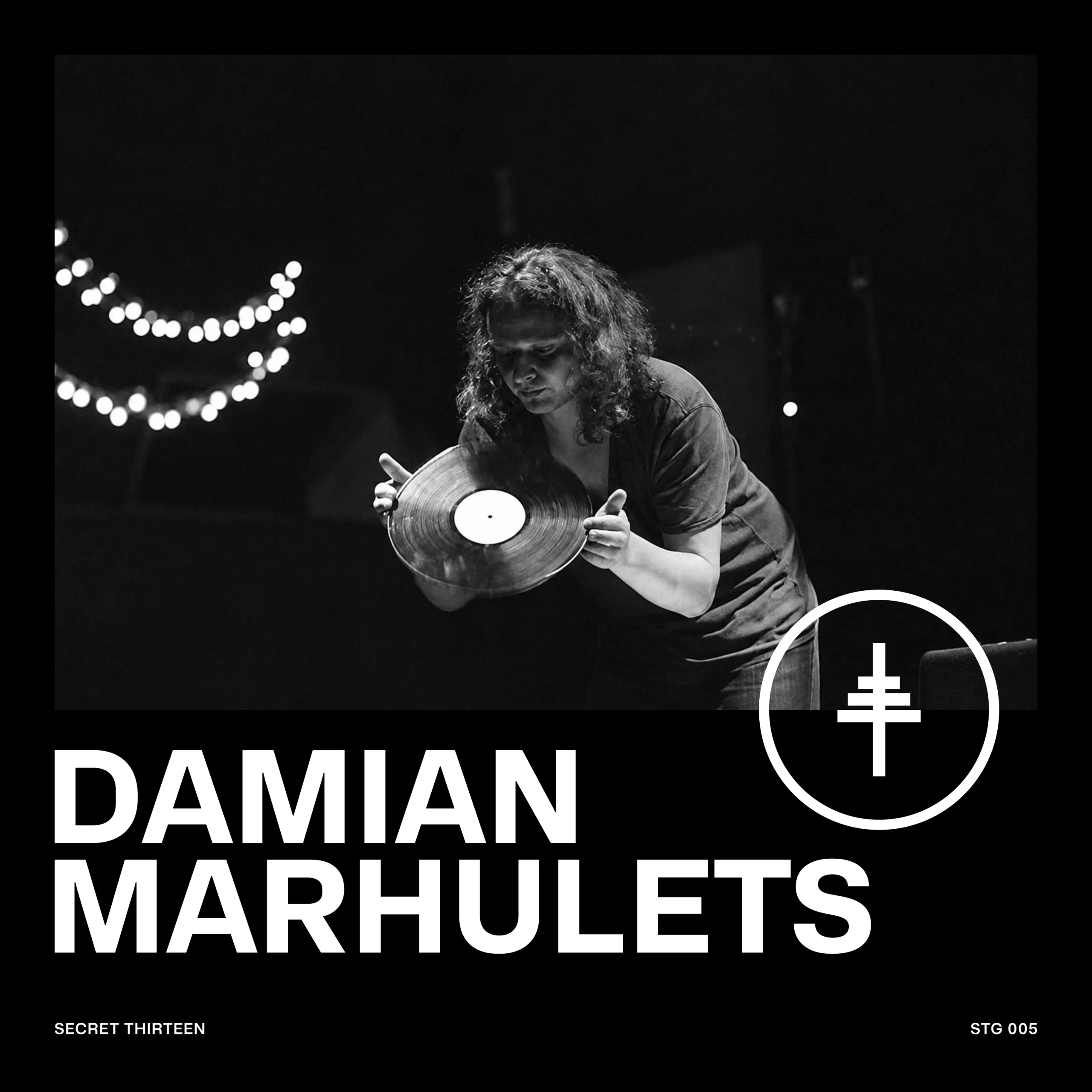
Age: 32
Name: Damian Marhulets
City/Country: Hannover, Germany
Occupation: Freelance Composer, Musician, Media Artist
Favourite music genre/style: All of them, really (with special fondness for baroque classical music, old school black metal and russian ‘80 synth wave)
Notable musical achievements: Damian Marhulets performed worldwide including Beethovenfest in Bonn, Music Triennale, „Acht Bruecken Festival“ and “New Talents” Art Biennale Cologne, Philharmonic Hall, Essen; ZKM, Karlsruhe; STEIM, Amsterdam; “Re:New” Digital Art Festival in Copenhagen, “Music21″ Contemporary Music Festival and “Ex.Tempore” Festival for improvised music in Hanover (Germany), “10Ms” Microsound Music Festival and “PlayWithFire” video art Festival in New York as well as other music festivals and DJ clubs.
– Works has been broadcasted by NDR Hanover, WDR and German Radio.
– 2011 – Solo CD Release („transit.nihil“) on Auster Records, Munic
Artistic Residences: ZKM, Karsruhe (Germany); ACROE, Grenoble (France); Ionian University, Corfu (Greece); STEIM, Amsterdam (Netherlands); Martin Kausche Atelie, Worpswede (Germany); Kuenstlerhof Shreyahn (Germany).
In the records

Damian Marhulets on the mix
Tell us your story about your musical path. When did it start, and how did it turn into what we hear now? How much time do you spend listening to music and exploring diverse catalogs? What record format do you prefer (digital or physical) and why? Also, what were your motives for entering “The Guide” competition apart from winning?
I started my musical education at the age of four and played my first concert at five. Originally coming from the classical music background – as a classically trained oboe and piano player – I started to develop my musical education towards avantgarde composition and electroacoustic music in the early 2000‘s. In a last decade I‘ve been mainly active as a performer in fields of free improvised music, live-electronic and experimental turntablism in particular. A couple of years ago I finished my composition studies at Music Academies in both Hanover and Cologne. Since then I work as a freelance composer and performer doing many solo and collaborative music projects as well as organize some experimental music events in Hanover, such as „ExTempore“ Festival for free improvised music…
I‘ve been interested in experimental forms of turntablism and DJing for many years and even wrote my academic thesis on this topic some time ago. Of course, as a music-junky I‘m interested in more traditional forms of DJing too, and play regular DJ sets every now and then. I already had some ideas regarding specific narrative structures for my new mixes, when I accidentally came across the Guide competition. Thus I decided to use this chance and to work on one of the ideas I had at that time.
Tell us more about this mix’s concept and ideology. Why did you choose this way of compiling and developing it? Did you have a clear idea from the very beginning or did it change after you started working on it? Does it hide any encoded message or specific emotions? Also, could you say that it is your best selection ever crafted?
The mix I did for the Guide competition is a conceptual work. By no means it‘s just a selection of some favorite tunes of mine. My main intention was rather to investigate the machinery of oneiroid narration with its turbulent flows and structural proliferations. The whole mix refuses to follow a linear development and tends to build a multidimensional structure – a multitude made out of narration anomalies and non-trivial chimeras. You can think of it as a pandemonium plane where every singularity constantly redefines itself. But please don‘t take it to serious, sometimes it‘s definitely worth a good laugh!
To which types of listeners is this mix most dedicated? Should these persons have more musical knowledge, spiritual balance or both? Could you describe these people in detail, thus revealing your individuality? Also, do you think that universal music exists?
This mix is dedicated in first place to all sleepwalkers, steam-punk-porn junkies, unicorn lovers, humble maniacs, chocolate monsters, little wolfgirls, deaf astronauts, bearded princesses, ordinary demons, depressive superheroes and acephalous cyborgs. And for everyone else – don‘t be afraid to loose your spiritual balance! Btw, this mix is 100% universalism-free.
What is your opinion of the current worldwide intelligent music scene? What do you think about it? What do you think about its future? What reach and attention does it have at the moment? Please write us your thoughts with examples, so that we know your insights and position.
It is undoubtedly hardly possible to speak about the music scene worldwide. There are just too many differences coming from both geographical location and definition of intelligent music scene as such. Speaking from my own experience, I sometimes wish the scene was more open and interconnected. Working myself in such different fields as classical music, turntablism, free improvisation, live-electronic, jazz or klezmer music to name just a few, I often wonder how hermetic all those little „music-universes“ are. Although I do enjoy the extreme fragmentation of music world with all its obscure slivers and beautiful deviations, I believe, that it is more than important especially for musicians to be able to constantly transgress own borders and explore the unknown musical neighbour realms.
Sources and image credits
- Original release artwork: Kid Koala — Some Of My Best Friends Are DJs.
- Original release artwork: The Books — Lost and Safe.
- Original release artwork: Fred Frith — Guitar Solos.
- Original release artwork: Paavoharju — Laulu laakson kukista.