
Joachim
Sauter
ART+COM / 1959–2021Finding the idea worth making.
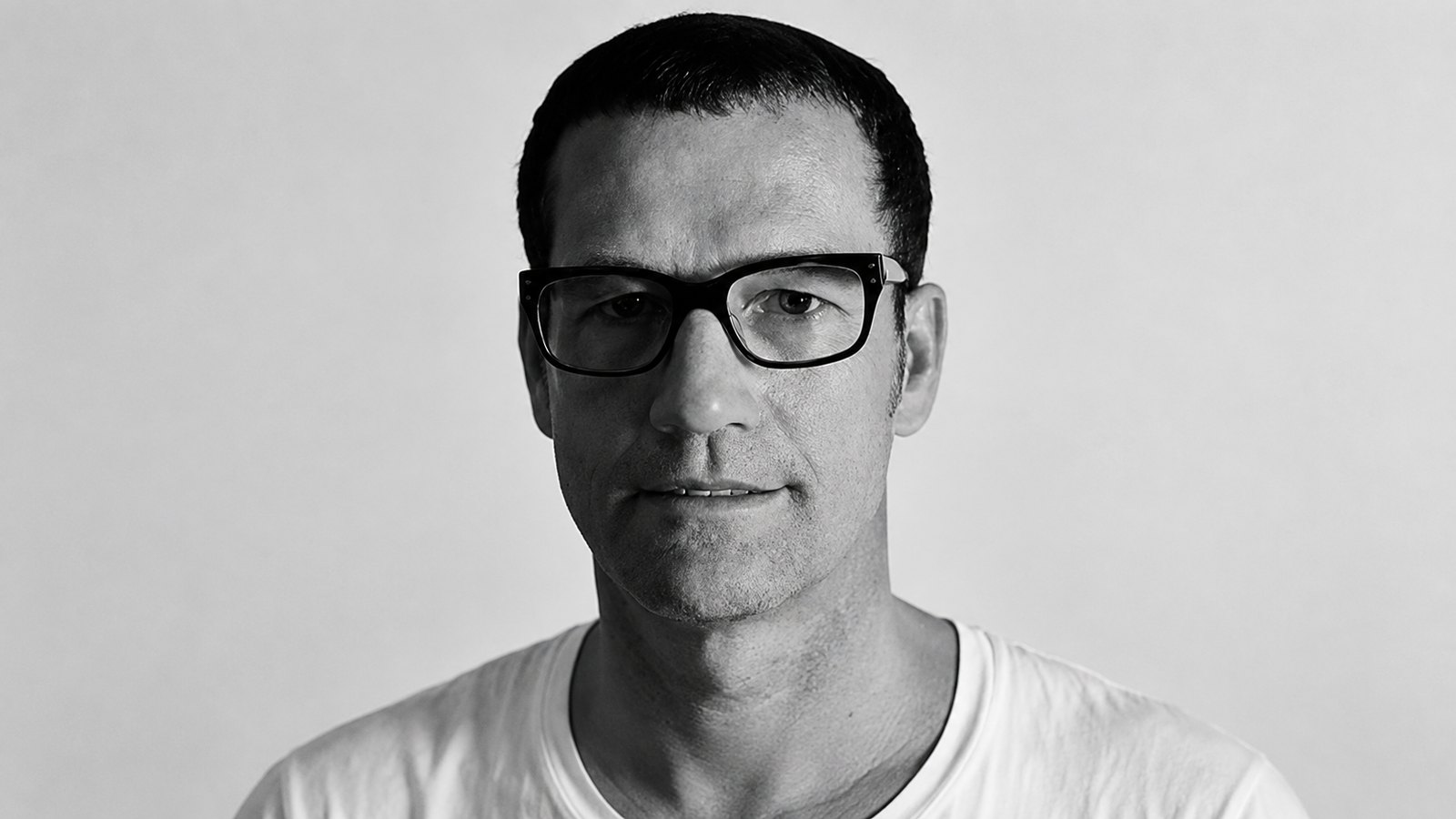
For Joachim Sauter, the difficult part of creative work was choosing which idea to pursue. His route through graphic design, film and media art gave him several ways to approach that decision. This July 2013 interview follows those connections through ART+COM’s work with physical space, movement and digital tools.
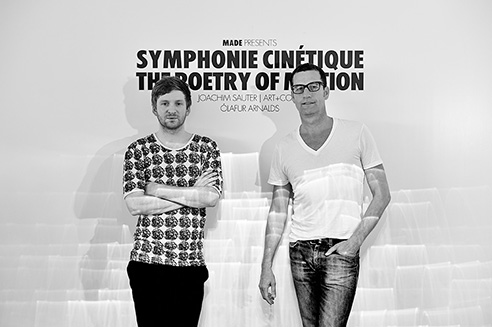
The conversation coincided with Symphonie Cinétique — The Poetry of Motion, his collaboration with Ólafur Arnalds at MADE in Berlin. Sauter died in 2021. We present his answers as a historical conversation, followed by a new editorial reflection on the work he left behind.
Introduction and archive edition by Justinas Mikulskis.
In this conversation
01 / ConversationThe value of taking detours
From our perspective, you are a very established artist. You know what you are doing. You have been doing it for a long time. You know how you are going to approach things. How do you feel this position helps you to move forward? How do you benefit from it?
In order to get to this point it took quite some detours, which in retrospective have been important and still influence my work. I started off by studying graphic design, then followed studies in film, which eventually led me to new media design and art. But it’s like getting to know a city: if you only walk in straight lines from one place to the other, you don’t see much and you will never understand the city’s entire geography. But if you take detours, explore alternative routes and check out neighbourhoods, you will progressively understand how the city is constructed. And on this basis you can make the right choices. For me, a creative director at ART+COM, this means that my knowledge of neighbouring disciplines makes it easier for me to assess the potential of an idea and to choose the right one. Because the difficult part in creative work is not to have ideas, but to pick the one that’s better than the rest.
Can you tell us a bit about your background? Where did you studied and who influenced you to explore arts? How important is it to you?
I studied at the Academy of the Fine Arts and at the German Academy for Film and Television, both in Berlin. In the beginning of my professional career I was definitely influenced by the design principles of Bauhaus, such as stripping away any decoration and celebrating clean lines of function and simplicity. I was also impressed with the permeability between architecture, design, fine arts, film and design that Bauhaus promoted. These strong ideas have shaped my own approach and have motivated me to define clear design principles at ART+COM. Our design work is still very much orientated towards simplicity and clarity of form, but it has become much more poetic, ambiguous and encrypted than in the beginning. Where we still follow the Bauhaus completely is in its disregard of conventional distinctions between the "fine" and "applied" arts or, in our words, „media art“ and „media design.“ But we even go one step further in the fact, that designers, programmers and developers work interdisciplinary at ART+COM. Through this teamwork and synthesis we are able to develop original ideas that are both technologically and aesthetically unique.
“Because the difficult part in creative work is not to have ideas, but to pick the one that’s better than the rest.”
02 / ConversationSpace and the physical world
Most of your works are very spacious. They include the interesting use of surrounding space, context. What is space to you? Is it a blank canvass or challenge to deal with?
First of all, space means challenge. The challenge lies in understand the space you create for. Very often our works are developed in response to a specific space. The installations that we invent for a given space often enhance it, bring it to the foreground, into people’s perception instead of covering it up. We like to think of it as adding layers to space, layers of information or of visual poetry. We create a dialogue between the space and our work that the viewer enters as a third and equal partner.
How would you describe the different phases of your work throughout your career and what are the themes or motivations that keep pushing your work forward?
ART+COM was founded as early as in 1988. Quite naturally my work has been influenced by the medium it is based on: the personal computer. The first seven years from 1988 to 1995 were defined by independent technological and artistic experiments and commissioned research projects. This position gave the freedom to maintain independent perspective on technological innovations often hyped as the future successes elsewhere, but which did not necessarily turn out as such. New technologies were analysed, often dismissed, developed further and “abused.” In this first phase, the new medium’s essential qualities like interactivity and connectivity were identified and explored in a series of art, design and technology projects. In 1996 ART+COM entered its second seven-year phase. Our projects outgrew the screen and entered physical space. The new medium was gradually gaining ground in the public mind, and our independent work was accompanied by first commercial commissions for communication projects. These projects consciously celebrated the technology, which was made explicitly present, and could be immediately experienced. They followed the increasing acceptance of new media in various walks of life and the resulting knowledge about interaction principles and the use of interfaces. The open skepticism and ignorance, which the medium had been treated with in the early years morphed into a naive enthusiasm and fascination, a mood which culminated with the burst of the New Economy Bubble at the start of the new millennium. In recent years, after two decades of communicating in the virtual space of the internet, a desire for more communication in real spaces has been making itself manifest. The circle to the pre-digital era is closing and the physical and corporeal is back in the spotlight again, though infused and shaped with the qualities of the new medium. The material is supplanting the immaterial; the virtual complements the narrative's physicality.
03 / ConversationChoosing the work
What tends to give you the greatest challenge and the greatest satisfaction with your work?
Next to my creative work at ART+COM I teach at the University of the Arts in Berlin (UdK) and at UCLA, Los Angeles. I became professor at the UdK at the age of 32, which was not only determined through the fact that design with new media was a new field and teaching personnel was rare back then. But I consciously reentered art school as a teacher, because I felt that it is important to share experience and knowledge not only inside ART+COM, but externally as well. Today some of my satisfaction with what I do and did is generated by the success that my students have. Seeing them making progress and growing makes me proud. In addition to this, it satisfies me to see that today ART+COM is one of the protagonists of spatial communication with new media with a 25 year long history, that we will actually celebrate in the mid of this year. In 1988 we started as a group of enthusiasts, who simply wanted to explore the computer as a new medium, and became a company much later, in 1994. We did not know what was waiting ahead – the burst of the internet bubble, that would shake the whole field and eventually broke many of our competitors’ necks. Luckily we survived, because ART+COM was built on a solid basis, not on venture capital, and had followed a clear line of business, instead of jumping on every opportunity that had shown up. The biggest challenge has been to reinvent and refresh us again and again without moving into the wrong direction. It means to have both good instincts and a strong attitude.
Kinetic Logo at Deutsche Bank BrandSpace Frankfurt from ART+COM
04 / ConversationMusic, movement and plans
How important is music to your life? Does it somehow influence your work? Could you share your recent favourite albums with our audience?
Music is very important to me both in my private life and for my work. When describing our artworks we very often speak of a visual choreography, which suggests sequences of movement in connection with sound and even if not all works have a sound component, many of them are in some way or another related to sound. This quality is going to be “made audible” in an exhibition of some recent kinetic works that will take place in Berlin in July this year. Invited by MADE, an event and exhibition space, we will cooperate with Olafur Arnalds, a young musician from Iceland who is well known for his compositions mixing strings and piano with loops and edgy beats crossing-over from ambient/electronic to pop. It’s an artistic experiment that we are all looking forward to. Olafur is going to compose a sound piece in response to the pieces that we show. In anticipation to this collaboration I currently like to listen to his latest release For Now I am Winter.
What are you working on now? What ideas or plans do you have for your future work? Could you elaborate on this?
At the moment I am working on a number of installations for indoor and outdoor public spaces. The common aspect of these different installations is the combination of reflective surfaces, light and movement, however all works respond individually to the context of the given space. With ART+COM studio I was invited to develop a concept for an artwork in Baku’s Heydar Aliyev Center, a new museum, gallery and conference centre, and the most ‚fluid’ architecture that Zaha Hadid Architects have ever built. Another, but very different spatial context for which I am working is the plaza of an office complex in the heart of Washington DC. The work that we conceived for this particular environment is a ‚time keeping piece’ that offers the current time only at closer view, while the predominant impression is hat of a constantly moving abstract form in visual interaction with the surrounding architecture. Of course, these are only two of the many projects we do at ART+COM and they are definitely more on the ‚arty side’ of our work. Alan Kay, the visionary IT pioneer at Xerox, said back in the 1970s: ”Look, the best way to predict the future is to invent it.” One of the challenges that we face in our field is that we indeed cannot just follow design trends and technological progress, but that we are the ones who set the directions. Asked for my plan for the future I can only reply very generally, that I am planning to do exactly this.
Beyond the demonstration
Sauter’s answer about taking detours is an unusually useful account of experience. Different disciplines give him ways to judge an idea before committing to it. I keep returning to that distinction: having more possibilities creates another kind of work, the work of choosing.
Five years after his death, this interview feels valuable for the questions it leaves with anyone working through technology. What does a piece ask of its surroundings? Why does it need to move? What is made possible by a computer that could not be said as clearly another way? Sauter’s attention to simplicity gives those questions a practical weight.
The physical work also asks for a viewer’s time. In Kinetic Rain, designed by ART+COM for Singapore’s Changi Airport, individually controlled drops form a changing choreography within a place people normally pass through. FELD’s account of its motion-design work describes how the sculpture changes with the viewer’s position. The experience belongs to movement through a real space.
A later work, AION, brings that relationship with music into particularly spare form. MKT, which engineered the installation at the University of the Arts Berlin, describes twelve pendulums connected through a mechanism that allows their movements to fall out of phase. Its project record dates the installation’s operation from 2022. The association with musical structure is present in the movement itself.
ZKM’s remembrance also points to Sauter’s influence as a teacher. I think that belongs beside the celebrated installations. Restoring the interview gives us access to the way he explained decisions, including the uncertainty and judgement behind a finished work. That part of an artist’s contribution is easy to lose when the archive becomes a sequence of impressive images.
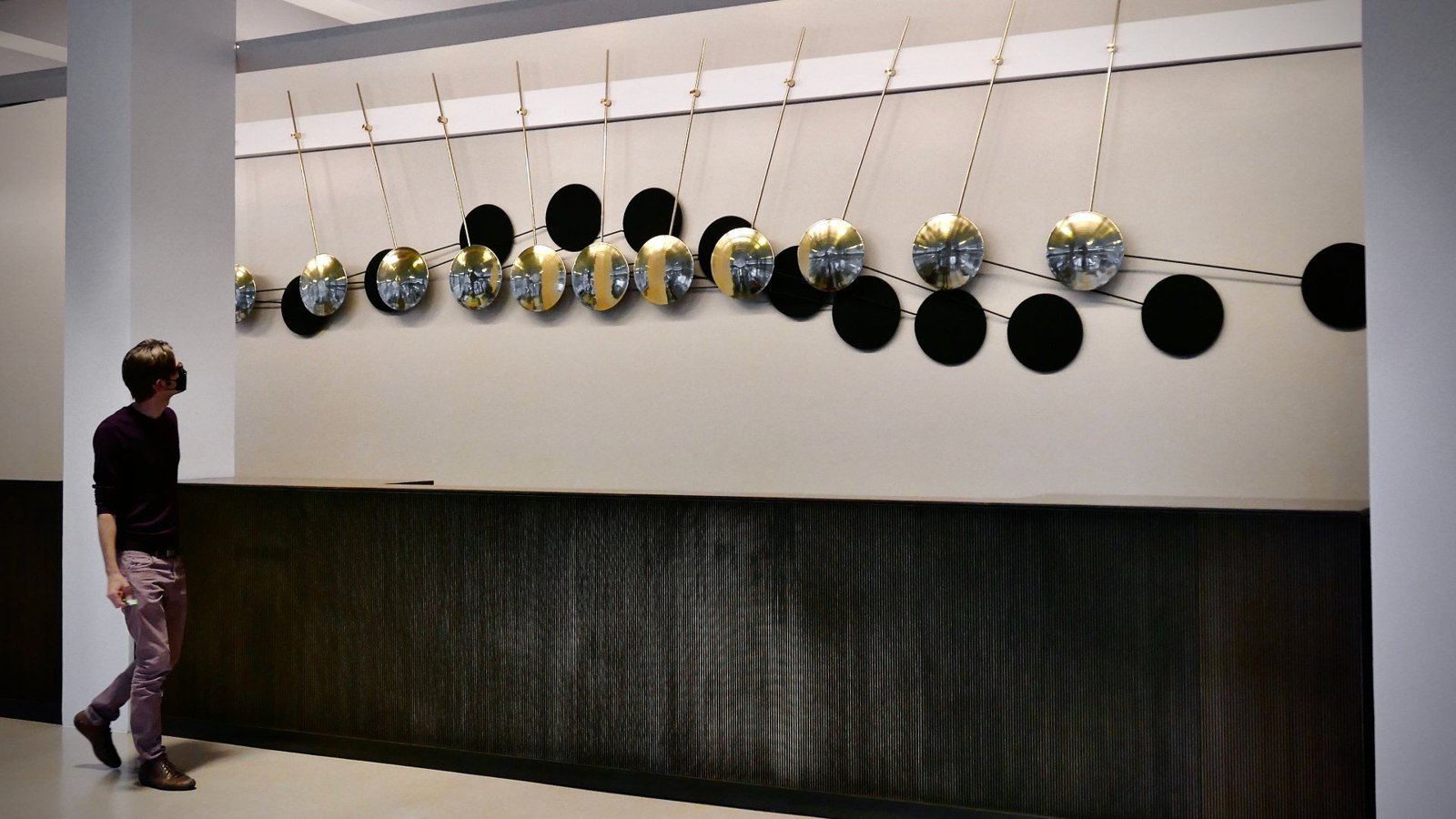
Project documentation and engineering details: MKT engineering — AION. Photographer not identified on the source page.
About this archive edition
Originally published on 7 July 2013. The complete questions and answers remain in their original sequence. References to current events, places of residence and forthcoming releases belong to that original date. New chapter headings, an introduction and an editorial afterword by Justinas Mikulskis accompany the historical conversation.
The featured portrait is an AI-assisted restoration and 16:9 crop of the original archive image. Original photographic credits are retained. Embedded players have been replaced by direct listening links where available. Album artwork is reproduced alongside links to the official release pages and their credits.
