Private archives, field recordings and performances by the artists themselves.
An artist’s own archive can reveal a different history from the one carried by released albums. A studio test, an unfinished piece or a performance preserves a decision while it is still being made; a field recording preserves the place and time to which the artist gave their attention. These contributions let us hear work beside the published discography, and sometimes the material from which that discography grew.
These ten recordings place the contributors’ own work at their centre. Private bodies of material from Dalglish, EVOL and Deaf Center sit beside Geistform’s hardware improvisation, modular performance and Moniek Darge’s recordings of everyday and sacred spaces. Ben Vida gives existing rhythms a newly synthesised form through digital tracing. We distinguish an uninterrupted performance from an edited session and a sequenced archive: each preserves a different form of making and listening.
Seventy-eight works made between 2000 and 2012, unpublished when this contribution appeared, become one unstable, densely layered recording. The scale of the private archive is important, but so is the way Chris Douglas puts those separate experiments into motion together.
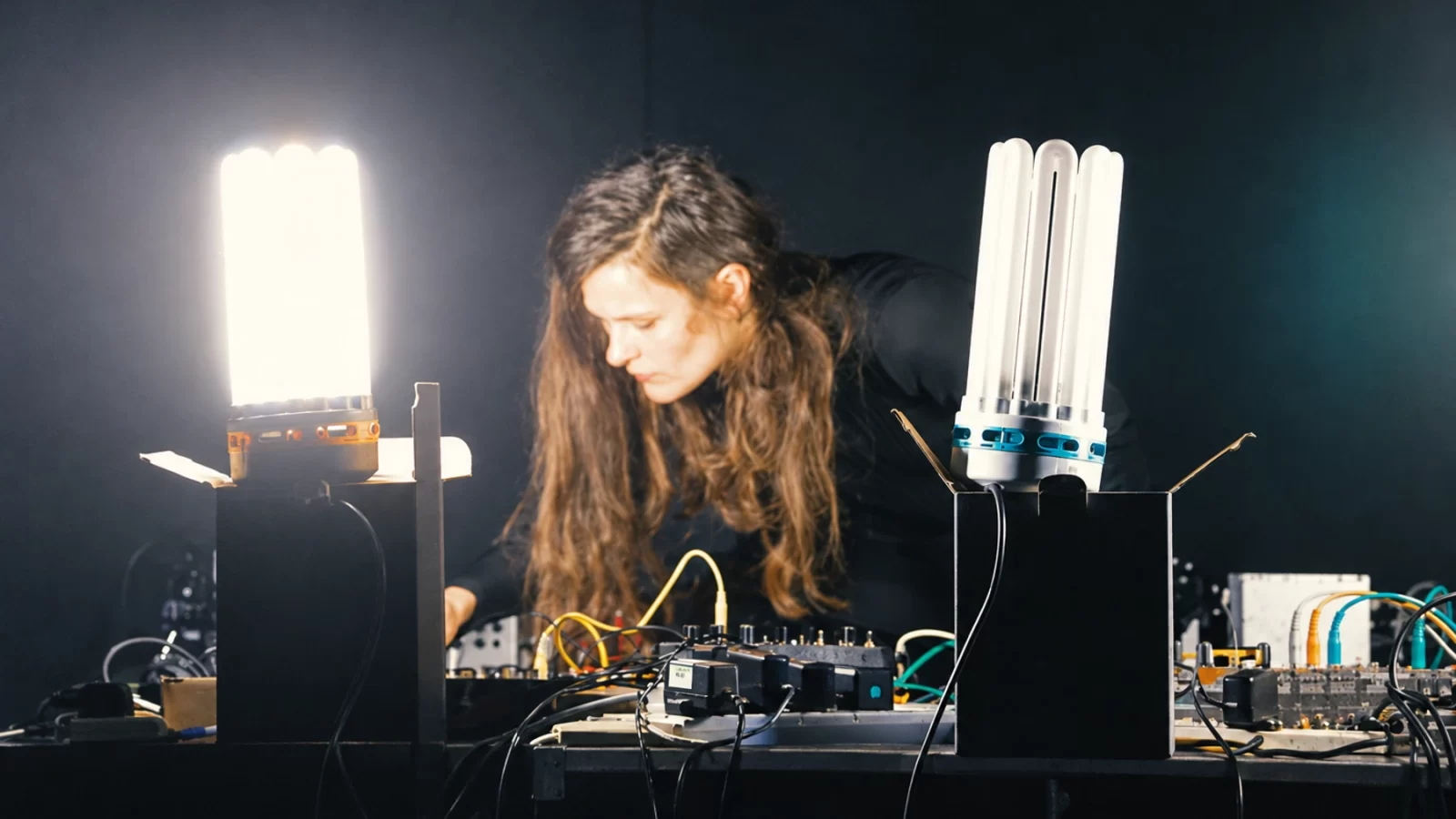
Geistform reworks nine of his own compositions in a live recording, allowing improvisation to change the pre-composed pieces. Samplers and sequencers meet a modified Korg MS20, other analogue synthesizers and effects, making this a document of his hardware process as well as his own music.
Studio tests, discarded edits and live fragments from 2009–2014 are joined through a split-channel technique. These recordings, unreleased at publication, expose the working material behind EVOL’s computer music and turn the archive itself into a new piece.
Recorded especially for the journal at 112 BPM, this performance was edited from a long night of studio improvisation. The newly connected equipment and unhurried session give the recording a precise place in the duo’s developing practice.
Vida’s nine compositions trace recordings by Conjunto De Tambores Batá De Amado Diaz Alfonso through MIDI mapping, turning existing rhythms into control signals for a modular synthesizer. The recording gives those traced rhythms a newly synthesised form, carrying the instability of his earlier hand-played percussion traces into a digital process.
Twelve recordings from 2003–2010 open the paths beside the duo’s albums: unfinished work, alternative versions and material from live shows. Unreleased when published, they make a substantial companion to the discography through their own sequence and internal relationships.
Recordings from 1984–2014 trace Darge’s own listening in public, domestic and sacred spaces, including her collaboration with Eric De Visscher. Her refusal to cut up or heavily process existing pieces gives this archive its particular form: places and compositions are allowed to keep their own acoustic lives.
Parasites Compressor begins with an unpatched modular system and develops in one take, without automation. Bayle builds its rhythmic logic from crossing low-frequency oscillators and amplified electrical noise; the process of connecting and directing the machines becomes the piece.
An exclusive live recording made in London in 2017, where analogue pulses develop into fast, unstable rhythmic structures. Its place here rests on the performance itself: a sustained document of Justka working with sound and machinery in real time.
A sequence made from ENA’s own material, recorded from 2018 up to this contribution’s 2019 publication and unreleased at that point. It opens a concentrated view of his studio language, where abstract atmospheres retain the physical memory of drum and bass.
Presented in original publication order. References to unreleased work describe its status when the contribution first appeared.