
DALGLISH
Chris Douglas / Sound, risk and responsibilityChris Douglas on the sounds that follow him into dreams, the limits of presets and why listeners should demand more.
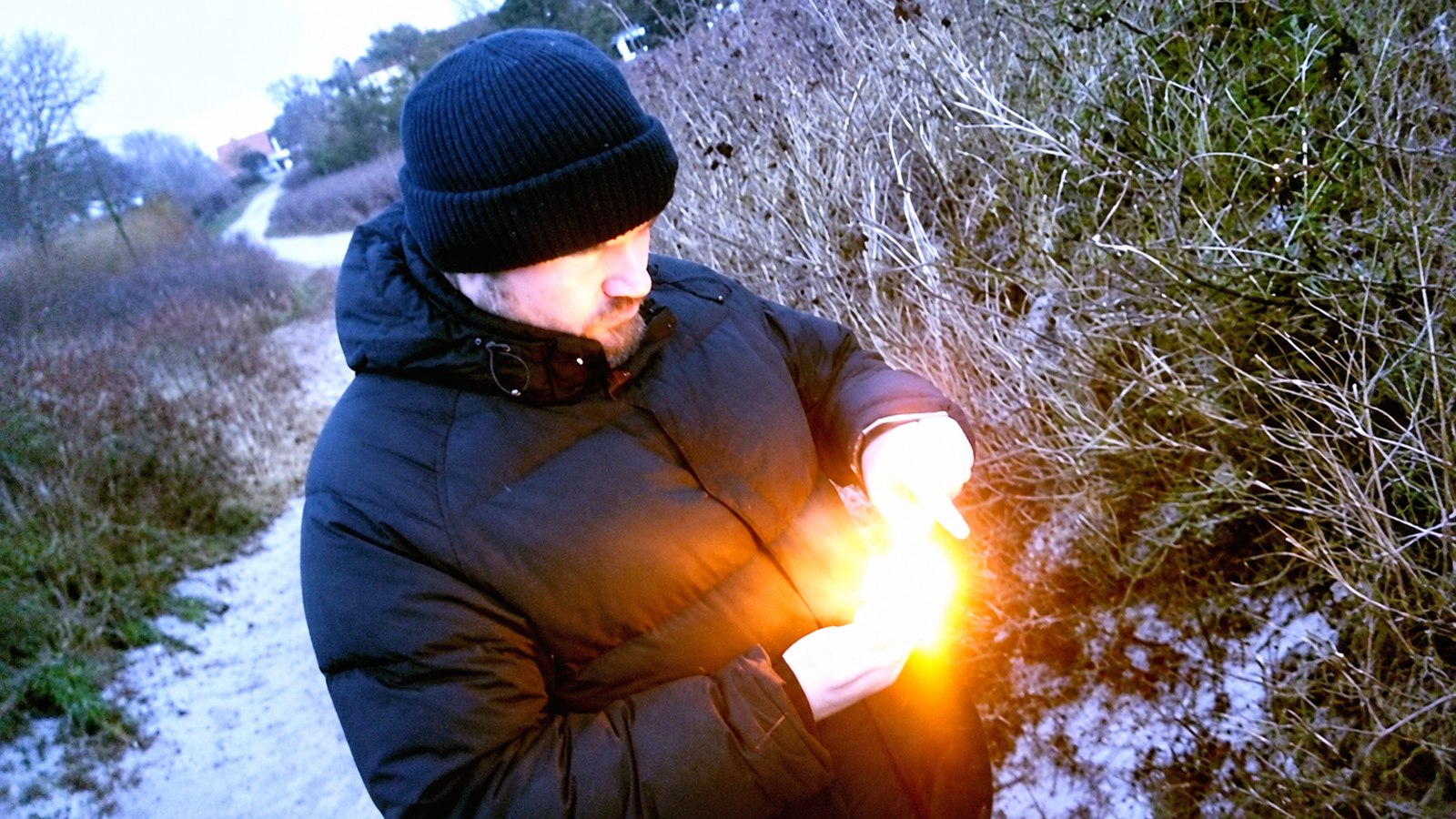
Chris Douglas refuses the idea that music can be separated neatly from the life around it. In this conversation from February 2013, he describes a practice shaped by whatever gets through: daily events, dreams, older compositions and the sounds he cannot filter out. The complex surfaces of his work lead back to a very direct statement about experience.
The interview takes Bytreqw, released as Scald Rougish, as one starting point. It also makes room for his impatience with electronic music that settles into familiar gestures. These are forceful, sometimes uncomfortable answers. Their value lies in the questions they leave with artists, listeners and those of us writing about music: what are we rewarding, and what are we prepared to hear?
Douglas had already contributed Secret Thirteen Mix 041, a live recording assembled from his own work. We have brought it into this edition as a listening companion. The full historical conversation follows, with a new editorial note and release links connecting its 2013 setting to his continuing Amhain catalogue in 2026.
Introduction and archive edition by Justinas Mikulskis.
In this conversation
01 / ConversationTime, life and the work
What does time mean to you in music? Apart from the duration of tracks does time exist in music? Do you repeat and transform sounds from the past in your music or do you create future sounds?
Time gets lost in everything doesn't it? I find that comforting. If something comes out spontaneously, and then when you listen to it, you can be absorbed in a time removed from present time. I do borrow from my older compositions and bring them into newer ones sometimes. So, I suppose it is a mixture of past, present and future.
How does your every day life, daily events influence your sound? How is your sound connected with your emotions? Or maybe your music exist in an entirely separate space detached from every day life, human emotions?
My work is a reaction to all the unfiltered things I experience inside and outside. I have great difficulty to filter all things around me, so, of course, human emotion is an integral part of the work. Life is contradictory; it's simple, complex, chaotic pleasure. There is no separation between my life and my work.
“There is no separation between my life and my work.”
02 / ConversationEvolution, dreams and discovery
Your new album " Bytreqw " on Icasea has been just released. Could you tell us what mood you were trying to develop and what is the message encoded behind all these complex layers? How different this work is from your another creations by looking at it from technological and experimentation perspective?
With this one and all my other works, beyond the personal aspects of it all, I try to display what is possible and where things should be by now; everything has to evolve. I find it disgusting and sad what has happened to Electronic music in last ten years, and especially Techno. Never thought it would become dominated by such bland ideas.
As mentioned before, I find this is the artist's job to do so – to evolve – otherwise you are the equivalency of a tribute band. Something that originated with such innovation seems to have gotten completely stagnant, too comfortable. Without this sincerity and evolution, we will become stuck in a never-ending loop of mediocrity where all is accepted, no one caring or questioning anything, and the work will be no different, just a repackaging of faked rebellion and simulated diversity that is already shaping today’s so-called subcultures.
Aphex Twin once said that he dreams some of his music. Your sound sometimes has this dreamlike, even surreal mood. Are you influenced by your dreams? Have you ever dreamed of a track?
Again, there's no real separation. Sometimes dreams seem more realistic than waking life. There are always noises in the background of my dreams, and they're probably mine. I'm not necessarily making music in dreams, but there's a lot of background sounds in them, and I've tried emulating them before.
There were many narratives in history related with vastness of the sky (e.g. in Hindu Brahma is born from egg, floating in the global ocean ). What process of the universe (or maybe astronomical object) inspires you most and why? Are you interested in astronomy, physics or math, in general? Your architectural and transdimensional music makes me think, that you have your opinion on all those subjects.
I have a great interest in all these things, of course. I don't like talking about specific references. Using direct references feels a bit desperate and meaningless these ‘parasitic” days. I think there's no separation between those subjects and music.
I find that constantly questioning, searching and endlessly experimenting is essential and should be instinctual. Through my personal studies, I've found a lot of inspiration in people who have used these influences inter-connectedly.
03 / ConversationResponsibility and the limits of tools
Nowadays, when almost everyone has the ability to make music, there tends to be more and more projects and genres. Are you afraid of it and is there any threat to music due to this? Could you mention some interesting new artists in the scene? What is so special about them? Or maybe you miss responsibility and sincere contribution to music? Elaborate on this.
I was reading an article the other day online comparing an artist who has just had their first release compared to a revolutionary computer music pioneer working in the 70s. Essentially, this new artist proclaimed using a laptop as an "underused" instrument. This left me confused, and slightly scared. I think it is a problem that anyone can do it now. I do miss a sense of responsibility and labour in music. Historically, this is nothing new, of course; when any genre reaches a certain level of popularity, sincerity can appear to become lost. This is obvious in mainstream music, but seems now to be reaching the more experimental/Electronic scene. We are forcefed a lot of shit, everywhere – especially in music -- and I'm amazed that people aren't angrier about this. People should demand more. That's the responsibility of the listeners, the journalists, and the artists.
Most major composers created music by using various self built systems (e.g. Arnold Schoenberg created his twelve tone technique - dodecaphony ). Do you have your own creative system and what do you think about systems in music in general? Is this a restriction or a way to perfection?
I think that a lot of classically trained people have a lot of restriction on their “individual” creativity, but I do appreciate when they can break away from their training to incorporate more personal expressions. I think the mind cries out for unpredictability. We need to be more entertained, surprised, and emotionally enveloped by works. When it comes to my own work, it's more of a spontaneous documentation, which may or may not be edited afterwards. Perfection is never attainable -- it should always be challenged. If by some chance, you reach perfection, life is over, or at least rather boring. No?
Recently the oldest (2500 BC) string instruments The Lyres of Ur were found. They were treated as heavenly invention back then. What do you think are the most interesting technological achievements in music nowadays? Is there anything still to be invented in music regarding instruments, sound, technology? What do you think is the future of intelligent music?
The ‘under used’ laptop, MAX/MSP, FM Synthesis, Modular synths, Kosmische/New Age Music and other catch all cliches. of course… Arse!!
But, seriously, I think a lot of technological advances by software and hardware companies have homogenized sound, mimicking what we used to have to discover for ourselves by experimenting with tape, synthesizers, pedals and other hardware. This is not a bad thing for people who already know how to use these tools, of course, but i feel that a lot of things that used to take more effort to achieve in the past can now be arrived at with simple presets. With this recent regurgitation of the ‘darker elements’ of music, it is hard to detect what is authentic anymore. If anything. People should demand more effort, honesty, more vulnerability and true risk and respect for history. It is dangerous when ignorance and egotism rule with no respect or need for experience.
So, you ask me what is the future of intelligent music? I'm not really sure what you mean...
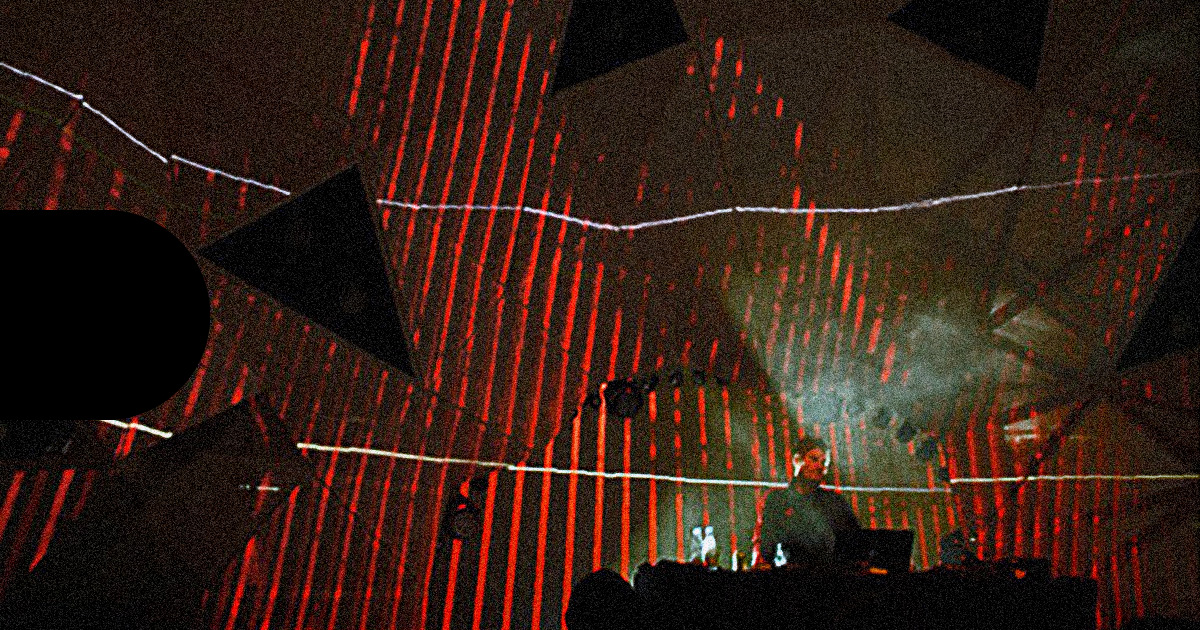
Secret Thirteen Mix 041
Dalglish
An exclusive live recording of 78 works made between 2000 and 2012, described as unreleased when this mix appeared. Douglas’s own material gives the interview’s discussion of time, return and experimentation a substantial listening companion.
What are we prepared to hear?
What stays with me here is the distance between Douglas’s account of making music and the language used to sell innovation. His working method sounds patient and uncertain: material returns from older pieces, dreams leave traces, a spontaneous document may be edited later. None of that requires an announcement that the future has arrived.
His criticism of easy access to production is more difficult. I would separate access from ambition. More people being able to make music is something to welcome; it does not relieve artists, editors or listeners of the need to make choices. A tool can make an unfamiliar sound available immediately. Deciding why that sound belongs in a piece still takes attention. The useful challenge in these answers is to keep that distinction alive.
There is a particular responsibility for a journal in his complaint about historical comparisons. Calling a new release revolutionary is easy. Explaining what it does, acknowledging its predecessors and giving it enough time is slower work. Republishing this interview means taking that criticism seriously, including when it applies to our own habits.
The accompanying live recording gives the conversation something concrete to stand beside. Its 78 works were described as unreleased when the mix appeared in 2012. It is an unusually substantial invitation to hear Douglas on his own terms. The release selection below then moves from the records around this interview to BC/5/26, issued as Amhain in May 2026. The archive opens onto a practice that continues beyond this particular name and moment.
About this archive edition
Originally published on 25 February 2013. The complete questions and answers remain in their original sequence. References to current events, places of residence and forthcoming releases belong to that original date. New chapter headings, an introduction and an editorial afterword by Justinas Mikulskis accompany the historical conversation.
The featured portrait is an AI-assisted restoration and 16:9 crop of the original archive image. The original articles did not identify the photographers. Other archive photographs are reproduced as originally published. The artist’s Secret Thirteen mix is embedded with a direct listening link; obsolete external embeds have been replaced by release links. Album artwork is reproduced alongside links to the official release pages and their credits.

1 Comment
Pingback: Vom Dröhnen der Drohnen. Oder: Männer, die auf Mac-Books starren | H(eard) I(t) T(hrough) The Bassline